
3 Things Markers Notice in the First 30 Seconds
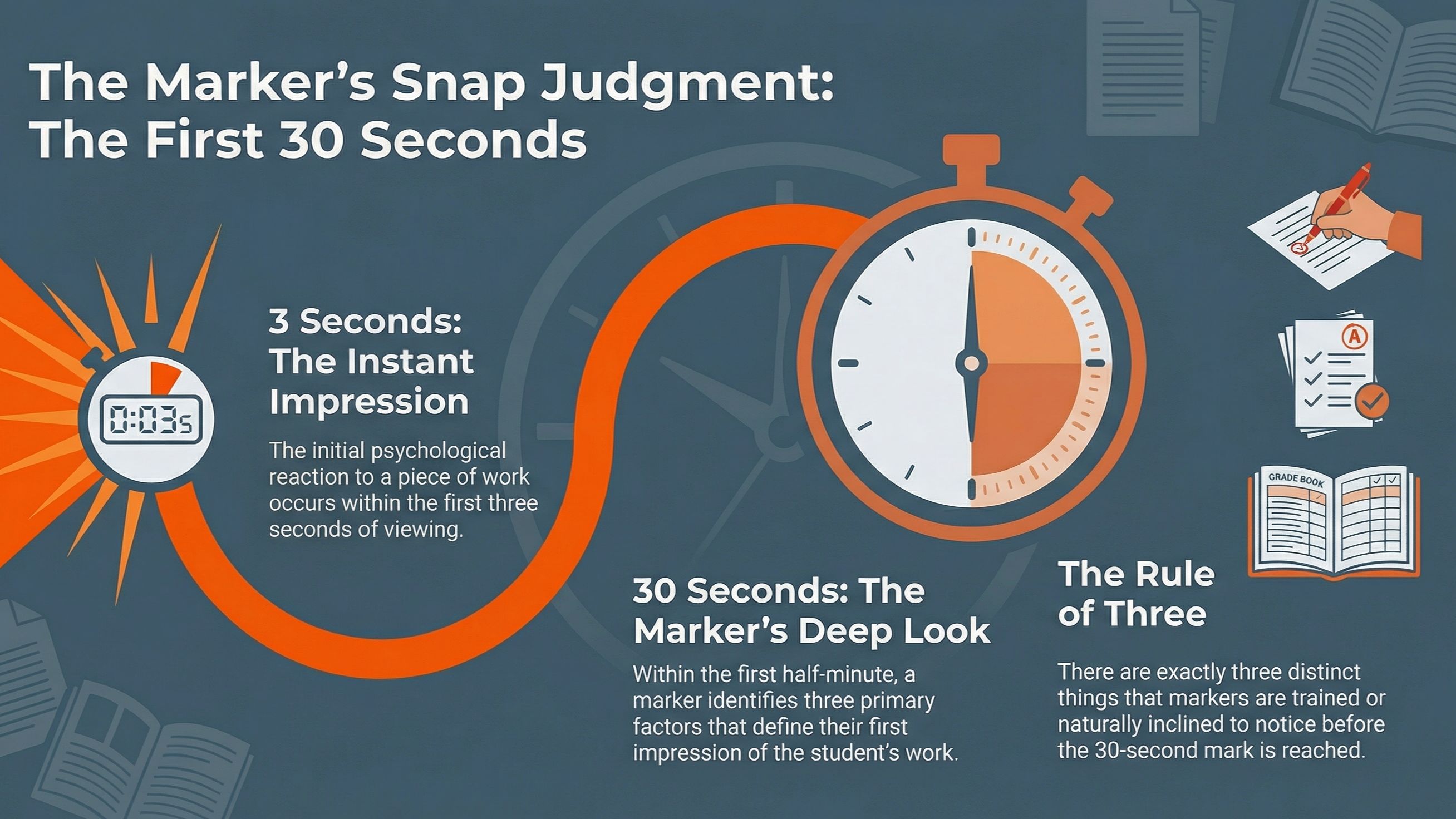
It's almost tragic how much time students spend perfecting individual sentences, only for their entire essay to be scanned, sorted, and effectively graded in under ten minutes.
Your marker doesn't add up marks as they read your essay. They don't tally points for each good paragraph and subtract for weak ones. They know your band within the first 30 seconds. Band 5 or Band 6. The rest of your essay just determines where you land within that band. A 17 or an 18. A 19 or a 20.
If you're lucky, exceptional analysis later might pull you up one band. But most of the time? You're stuck where that first impression placed you.
This isn't unfair. It's pattern recognition. After thousands of essays, markers know what Band 6 thinking looks like when it appears on the page. And they know within half a page whether they're reading it or not.
In those first few minutes, the marker is asking:
- Does this response have a clear, sustained argument?
- Does each paragraph do work, or merely exist?
- Is the essay structurally controlled, or does it wander?
- Do ideas accumulate—or reset every paragraph?
This is the uncomfortable truth:
perfecting sentences does not save a weak argument.
But a strong argument can survive imperfect sentences.
Here's what they're seeing in those first 30 seconds.
1. How You Handle the Question Shows If You Can Actually Read
Question: "How does your text challenge assumptions about representation?"
Your response: "Texts use various techniques to represent complex ideas and challenge readers' perspectives."
You just copied the question's words without engaging with what it's asking.
The question isn't asking if your text challenges assumptions. It's asking how. The mechanism. The textual process. When you parrot the question's language back without analytical specificity, you're advertising you didn't understand it.
Markers spot this instantly. They're reading your thesis looking for proof you've processed the conceptual demand, not just pattern-matched keywords.
Weak responses restate the question. Strong responses answer what the question is actually testing. By the end of your introduction, the marker knows if you're responding to the question or just writing the essay you memorized.
2. Your Structural Sentences Reveal If You Can Build an Argument
Markers read three sentences before they know your band: your opening sentence, your thesis, your first topic sentence.
Most students open with context. "Written in 1818, Mary Shelley's Frankenstein explores themes of ambition." That's not analysis. That's stalling.
Then their thesis uses abstract filler: "Through complex characterization and sophisticated techniques, the text explores the multifaceted nature of identity." Words like "explores," "complex," "multifaceted" are camouflage for empty thinking.
Then their topic sentence announces a theme: "One way the text represents identity is through the protagonist's journey." That's description, not analysis.
These three sentences tell the marker everything. You're working from memorized themes, not textual observation. You're announcing topics, not making claims. You're describing content, not analyzing construction.
Strong essays do the opposite. They open with analytical claims about textual mechanics. Their thesis contains specific techniques and specific effects. Their topic sentences make argumentative moves, not thematic announcements.
The marker doesn't need three paragraphs to spot the difference. Three sentences is enough. Weak structural sentences predict weak analysis throughout. The pattern never fails.
3. Your Evidence Is Generic and Everyone Else Used It Too
Your marker has read the same five quotes 47 times today.
You think you're being thorough by using the most famous lines from your text. You're actually signaling you relied on class notes instead of engaging with the text yourself.
When your essay contains the exact same evidence as 30 other essays from your cohort, in the exact same order, analyzed for the exact same techniques, the marker knows you're working from a shared resource. Probably a study guide. Possibly your teacher's sample essay.
This matters because overused evidence correlates with surface-level analysis. Students who think independently choose quotes based on specific analytical needs. Students who memorize choose quotes because everyone else did.
The marker can tell which category you're in by your second piece of evidence. Original evidence selection proves you read the text looking for patterns. Generic evidence proves you read someone else's analysis and borrowed their observations.
Band 6 students use quotes other essays don't because they're answering questions those essays didn't ask. Their evidence serves specific analytical purposes, not generic thematic coverage.
Your marker spots generic evidence instantly. They've seen it repeatedly. And every time they see it, it predicts the same thing: competent summary, weak analysis.
The Real Problem
You're optimizing the wrong variable.
You're refining sentences when you should be building arguments. You're memorizing quotes when you should be choosing evidence. You're perfecting your introduction when you should be practicing to answer various types of questions.
The students who miss Band 6 aren't less capable. They're just solving a different problem than the one they're being assessed on.