
Why Short Responses Predict Your Entire English Mark
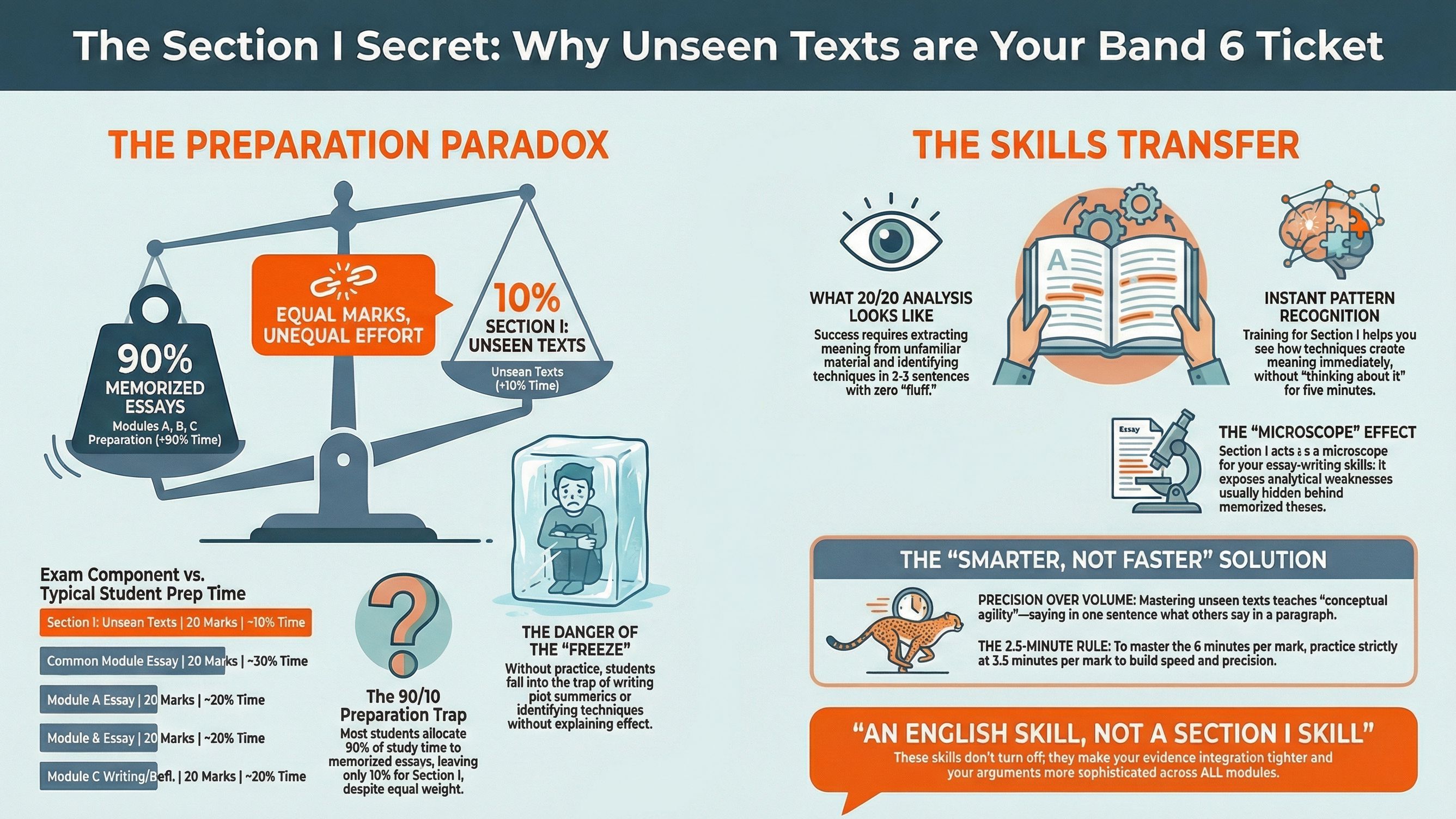
Every Year 12 student has their Common Module essay ready months before trials. Module A, B, C? Memorized, workshopped, refined to perfection. They've written their prescribed text essays so many times they could recite them in their sleep.
But Paper 1, Section I? The unseen texts section? That gets a week. Maybe two if they're organized.
Here's the problem: Section I is worth 20 marks. Your Common Module essay? Also 20 marks. Your Module A essay? 20 marks. Module B? 20 marks. Module C? 20 marks.
Yet students allocate 90% of their preparation time to essays and maybe 10% to unseen analysis. The strategy doesn't match the stakes.
The Marks You're Leaving on the Table
Picture this: You walk into Paper 1 with a flawless Common Module essay. Your thematic framework is sophisticated. You've got layered textual evidence, precise integration, a thesis that demonstrates genuine insight.
Then you hit Section I. Six minutes per mark. Three unseen texts you've never seen before. Questions demanding immediate analysis of technique, form, perspective, and meaning.
And you freeze.
You write plot summary instead of analysis. You identify a metaphor without explaining its effect. You spot personification but can't articulate why it matters. You run out of time on a 6 markers question and scribble two sentences that barely constitute a response.
Your perfect Common Module essay? Irrelevant. You just lost your Band 6 in the first 40 minutes of the exam.
The Real Reason Section I Matters
But the mark allocation isn't even the real insight.
The real insight is this: mastering unseen text analysis makes you better at everything else.
Think about what a 20/20 Section I response requires:
- Immediate textual analysis under pressure
- Extracting meaning from material you've never encountered before
- Identifying techniques and explaining their effect in 2-3 sentences
- Linking form to thematic meaning without waffle or description
- Precision. Zero room for fluff. Every word earning its place.
These are the exact skills that separate Band 5 essays from Band 6 essays.
The difference between a good Common Module essay and a great one isn't more quotes. It's sharper analysis. Tighter integration. Conceptual agility. The ability to say in one sentence what weaker students need a paragraph to express.
Section I is your essay-writing skills under a microscope. Every analytical weakness gets exposed in six-minute intervals with texts you can't prepare for. There's no memorized thesis to hide behind. No scaffolded structure your teacher helped you build. Just you, an unseen text, and a timer.
The Skills Transfer You're Missing
Students who can consistently nail 6-mark unseen responses in 6 minutes have developed something more valuable than Section I competency.
They've developed:
Instant pattern recognition. They see how techniques create meaning without needing five minutes to think about it.
Analytical precision. They know the difference between identifying a technique and explaining its effect. They never confuse description with analysis.
Conceptual flexibility. They can handle unexpected angles, unfamiliar text types, and questions that don't match their prepared frameworks.
Time efficiency. They know exactly how much analysis is required for each mark. No over-writing. No under-writing.
Now transfer those skills to your Common Module essay. Your Module A comparative. Your Module C reflection.
You're not just writing faster. You're writing smarter. Your evidence integration tightens. Your analysis sharpens. Your conceptual arguments become more sophisticated because you've trained yourself to extract maximum meaning from minimum time.
The Paradox Nobody Talks About
Here's the preparation paradox: students practice prescribed text essays because they feel more substantial. They're longer, they're what you study in class, they're what your teacher workshopped for weeks. Section I feels minor by comparison, something you can handle on the day.
But Section I is actually harder to execute than any essay.
With prescribed texts, you've analyzed them dozens of times. You know your thesis. You've pre-structured your response. Even under exam pressure, you're performing something rehearsed. You have anchors. Familiarity. Backup quotes if your first choice doesn't fit.
Section I? Completely unseen material. Unknown question angles. No preparation to fall back on except your raw analytical processing speed.
The students who wing Section I are gambling on skills they've never actually tested under exam conditions. The students who practice unseen analysis weekly are building capabilities that extend far beyond those 20 marks.
What Changes When You Take This Seriously
When you start treating Section I as diagnostic rather than incidental, something shifts in your entire approach to English.
You practice unseen text analysis weekly, not the week before exams. You time yourself strictly (2.5 minutes per mark). You learn to spot techniques and articulate their effect in a single breath. You stop writing long-winded responses and start writing precise ones.
And then you notice: your Common Module analysis gets tighter. Your Module B quote integration becomes seamless. In Module A, you stop using three sentences when one sharper sentence will do the work better.
Because you've trained yourself to extract maximum meaning from minimum time with material you've never prepared. That's not a Section I skill. That's an English skill.
And once you've built it, it doesn't turn off when you write about texts you have studied for months. It makes everything you write better.
The Bottom Line
Section I isn't just 20 marks. It's a predictor of your analytical capability under pressure, your ability to process unfamiliar material quickly, and your precision in articulating meaning without scaffolding.
They're sharpening every analytical skill they'll need across Paper 1 and Paper 2. They're building the kind of precision and flexibility that turns good essays into Band 6 essays.
Your Section I performance is revealing what you're actually capable of when you can't rely on memorization and preparation.