
Building An Anchor: The 4 Most Versatile Critics Every HSC Student Should Know
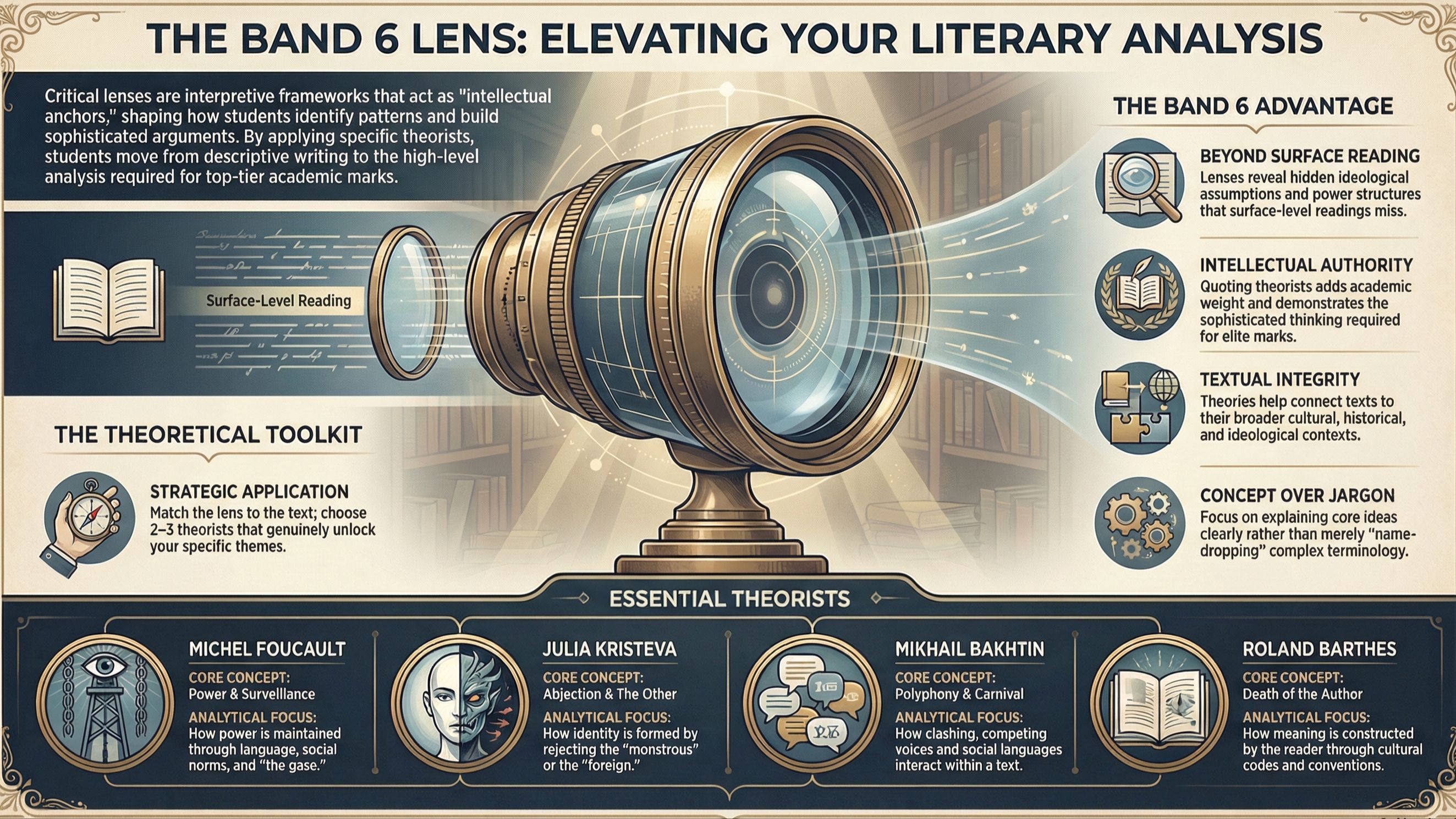
The best HSC students don't just read more. They read through something. A lens. A framework. An intellectual anchor that shapes how they notice patterns, ask questions, and build arguments that markers haven't seen fifteen times already.
This blog will show you exactly how to build that advantage.
What You'll Learn
- What critical lenses actually are (and what they're not)
- Why they matter for Band 6 performance
- Four theorists whose ideas work across any text type
- How to apply each lens with concrete examples
- How to start building your own theoretical toolkit
👉 Want to understand why wide reading matters in the first place? Check out The Compounding Curve of Reading: The Hidden Advantage in HSC English to see how knowledge builds on itself.
1) What Are Critical Lenses?
Critical lenses (also called literary theory or critical frameworks) are interpretive tools that help you analyse texts from specific angles.
They're not rules about what a text means. They're not "correct interpretations." They're frameworks that train you to notice what's operating beneath the surface: power, exclusion, language, ideology, intertextuality.
The same text read through different lenses reveals completely different things:
Two Levels of Theory
Critical theory operates at two levels, and understanding the distinction matters.
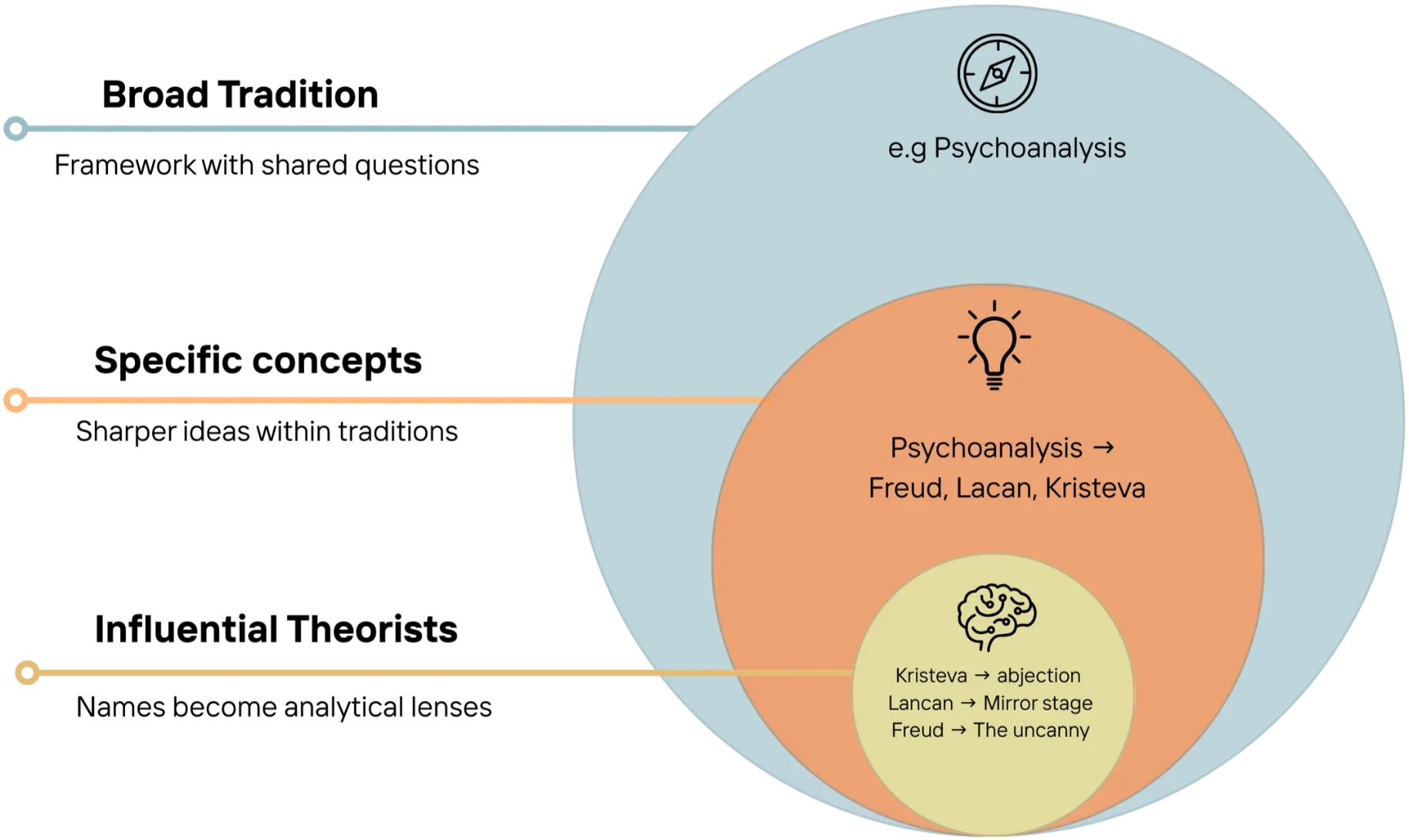
Broad theoretical schools are umbrella frameworks with shared concerns, methods, and questions. These are entire traditions of thought:
- Feminist criticism asks questions about gender, power, and representation
- Marxist criticism examines class, labour, and economic structures
- Psychoanalytic criticism explores the unconscious, desire, and repression
- Ecocriticism analyses relationships between humans and the environment
Dozens of theorists work within each framework. They share core concerns but develop different concepts and approaches.
Individual theorists develop specific, distinctive ideas within (or across) these broader schools. When their concepts are sharp enough and influential enough, their name becomes shorthand for a particular analytical approach.
For example:
- Feminist criticism includes Simone de Beauvoir, Judith Butler, Hélène Cixous
- Psychoanalytic criticism includes Freud, Lacan, Kristeva, Žižek
- Post-structuralism includes Foucault, Derrida, Barthes
2) Why Critical Lenses Matter for Band 6
Here's what critical lenses let you do:
- Connect texts to their broader cultural, historical, and ideological context. Critical lenses show you how texts both reflect and challenge the values of their time, how they respond to social movements, political climates, and dominant belief systems. This is what markers mean by "textual integrity": understanding the text as a product of its world and as something that speaks back to that world.
- Generate original insights that other students miss because they're reading at surface level. You move beyond obvious observations to uncover the deeper ideological assumptions, power structures, and cultural values embedded in the text.
- Quote critics to add authority and intellectual weight to your arguments. Rather than relying solely on personal interpretation, you can support interpretations with academic rigour.
- Answer unfamiliar questions confidently because you have frameworks that work across any text. Even if you've never seen the essay question before, your critical lenses give you analytical tools that apply universally.
- Demonstrate sophisticated thinking, which is precisely what Band 6 descriptors require. Markers want analysis, not description.
The students who consistently hit Band 6 have internalised one or two theoretical frameworks so deeply that they see texts differently. They notice things. They ask better questions. And when they write, their analysis has a coherence and depth that comes from thinking through a lens rather than grasping for random observations.
This blog focuses on four theorists/lenses whose ideas are:
- Universal applicability: Their ideas work across poetry, prose, drama, and film
- Conceptual clarity: You can learn their core ideas in one sitting
- Analytical power: They help you say things other students can't
Michel Foucault: Power, Surveillance & Discourse
Core Idea
Power isn't just held by kings or governments. It's embedded in language, institutions, social norms, and even how we see ourselves. Foucault's work asks: how does power operate invisibly? How do we become complicit in our own regulation?
Key Concepts
Panopticism: Derived from Bentham's prison design where prisoners can never know if they're being observed, so they internalise surveillance and regulate themselves. Foucault argues this logic extends everywhere: social media, schools, workplaces. We discipline ourselves because we assume we're being watched.
Discourse and Normalisation: Language doesn't just describe reality. It produces it. The categories used by institutions (governments, media, medicine, education) create ideas of what's "normal," "deviant," or "true." Control the discourse, control how people think.
Biopower: Modern states control populations not through violence but through the management of life itself: healthcare, education, public health campaigns, data. Power becomes productive. It doesn't say "no." It says "this is how healthy, normal, successful people live."
Why Foucault Works Everywhere
Every text involves power. Who has it? Who doesn't? How is it maintained, challenged, or hidden? Foucault gives you vocabulary to discuss invisible power structures, the politics of language, and how individuals become subjects of systems they didn't choose.
Application Examples
| Text Type | Foucauldian Focus | Broad, Reusable Interpretation |
|---|---|---|
| Dystopian Fiction (e.g 1984) | Surveillance as self-discipline | In dystopias, institutions rarely need to enforce power directly. A Foucauldian reading shows how characters internalise the threat of observation, regulating their own behaviour long before punishment occurs. |
| Visual Text (Photograph, Film, Documentary) | The gaze as a tool of control | Who controls the gaze? Who is made visible? A Foucauldian reading reveals how the camera disciplines bodies, turning subjects into objects to be known, categorised, or judged. The audience becomes a complicit surveillant, participating in the very structures of power the text critiques. |
Starter Question for Any Text
"Who holds power here, and how is that power maintained through language, surveillance, or social norms?"
Further Reading
- Discipline and Punish (1975), Part Three: "Panopticism" (the key chapter, around 30 pages)
- "The Subject and Power" (1982), a short essay where Foucault summarises his approach
- For secondary sources: Gary Gutting's Foucault: A Very Short Introduction is genuinely accessible
Julia Kristeva: Abjection, Boundaries & The Other
Core Idea
We define ourselves by what we reject. The "abject" is whatever threatens the boundaries of the self: death, decay, bodily fluids, the foreign, the monstrous. Horror, disgust, and exclusion reveal deep anxieties about identity. Kristeva's work asks: what must be cast out for identity to feel stable?
Key Concepts
Abjection The visceral reaction to something that disturbs identity or order. Corpses, waste, rot, the uncanny, the ambiguous. The abject is what we expel to maintain a sense of clean, bounded selfhood. But it never fully disappears. It lingers at the edges, threatening to return.
The Other Identity is constructed through exclusion. We define "us" by rejecting "them." The Other is whatever a culture, society, or individual pushes to the margins to secure a sense of coherent identity. Women, Foreigners, the sick, the mad, the criminal, the monstrous.
Borders and Boundaries Societies and selves need borders to feel stable. Kristeva shows how those borders are never natural or fixed. They require constant maintenance, constant policing, constant anxiety about what might cross over.
Why Kristeva Works Everywhere
Kristeva explains why certain things are considered "other," "unclean," or "monstrous." She's essential for texts about identity, belonging, horror, social exclusion, bodily experience, or the politics of disgust.
| Text Type | Kristevan Focus | Condensed Analytical Approach |
|---|---|---|
| Gothic / Horror | The abject as the return of what is repressed | Monsters expose what society tries to expel. Horror comes from boundary collapse (dead/alive, human/inhuman). The “civilised” world confronts what it has rejected. |
| Migration / Diaspora | The foreigner as threat to identity | Outsiders are constructed as dangers to cultural “purity.” Abjection explains xenophobia: the foreigner must be symbolically expelled to stabilise the social body. |
| Coming-of-Age | Bodily transformation as abjection | Adolescence brings encounters with the abject (sexuality, change, mortality). Identity forms through what the protagonist accepts or rejects in this bodily shift. |
Starter Question for Any Text
"What or who is being excluded, rejected, or treated as monstrous here, and what does that exclusion reveal about the anxieties of this world?"
Further Reading
- Powers of Horror: An Essay on Abjection (1980), especially the opening chapter
- Strangers to Ourselves (1991) for her work on foreignness and otherness
- For secondary sources: Kelly Oliver's Reading Kristeva provides clear summaries
Mikhail Bakhtin: Dialogue, Polyphony & Carnival
Core Idea
Bakhtin starts from a simple observation: language is social. Every word you use has already been used by others, shaped by their contexts and intentions. Texts inherit this. They contain competing voices, clashing registers, different social languages pulling in different directions. Meaning comes from the interaction, not from any single authoritative voice.
Key Concepts
Dialogism: No utterance exists in isolation. Every word is "half someone else's," shaped by how it's been used before and anticipating how it'll be received. Characters don't speak from nowhere. They draw on genres, registers, prior contexts.
Polyphony: Some texts contain multiple voices with genuine independence. They clash, contradict, coexist. No single view wins. Think of novels where you can't pin down what the author "really thinks" because the voices won't resolve.
Heteroglossia: Different classes, professions, generations speak differently. Novels play with this: official language against slang, high against low, institutional speech against street talk.
Carnival: Moments where hierarchies flip, authority gets mocked, the "low" wins over the "high." Satire, parody, grotesque humour. Carnival doesn't destroy power. It shows how arbitrary power is.
Why Bakhtin Works
Bakhtin gives you tools to analyse how voices interact within texts, how language carries social and ideological undertones, and how texts can subvert or reinforce authority. He's essential for anything involving multiple perspectives, intertextuality, satire, or politics.
| Text Type | Bakhtinian Focus | Condensed Analytical Approach |
|---|---|---|
| Novels with Multiple Narrators | Polyphony & ideological conflict | Which voices genuinely speak, and which are absorbed by a dominant perspective? How do different “social languages” expose class, worldview, or ideological tension? |
| Satirical / Parodic Texts | Carnival & the grotesque | How does the text flip hierarchies—mocking the “high” through the “low”? What does bodily humour or inversion reveal about the instability of authority? |
| Intertextual Works | Dialogism across texts | How does the work echo, rewrite, or argue with earlier genres or voices? What intertextual dialogue shapes its meaning? |
Starter Question for Any Text
"Whose voices are present here, and how do they interact, clash, or compete for authority?"
Further Reading
- The Dialogic Imagination (1981), especially the essays "Discourse in the Novel" and "Epic and Novel"
- Rabelais and His World (1965) for carnival theory
- For secondary sources: Michael Holquist's Dialogism: Bakhtin and His World is a solid introduction
Roland Barthes: Signs, Codes & The Death of the Author
Core Idea
Barthes starts with a provocation: the author doesn't matter. Once a text is written, the author's intentions, biography, and psychology become irrelevant. What matters is how the text works. Meaning gets made by readers activating the codes, conventions, and cultural knowledge they bring to the page. Every text is a weave of prior texts, and reading is an act of production, not consumption.
Key Concepts
The Death of the Author: Focusing on "what the author meant" closes down interpretation. Barthes argues you should ask how the text produces meaning, not what the writer intended. This frees you to analyse the text itself rather than speculating about someone's psychology.
Readerly vs. Writerly Texts: Readerly texts guide you toward a single meaning. Writerly texts demand you produce meaning yourself. They're plural, open, contradictory. Barthes values texts that make readers work.
Codes: Texts operate through codes readers recognise: mystery and enigma, action and sequence, symbolism, connotation, cultural references. Analysis means unpacking which codes are being activated and how.
Why Barthes Works Everywhere
Any question about "how meaning is made" is a Barthes question. He's essential for close reading, for understanding connotation, for analysing how texts manipulate expectations, and for any response that needs to discuss technique and construction rather than content alone.
| Text Type | Barthesian Focus | Condensed Analytical Approach |
|---|---|---|
| Poetry | Connotation & the semic code | How do word choices trigger cultural associations beyond literal meaning? How do sound, rhythm, and form generate additional layers of significance? |
| Genre Fiction | Codes & conventions | What genre expectations are activated or subverted? How does the text use mystery or suspense (hermeneutic code) to engage readers? What shared cultural knowledge does it rely on? |
| Visual Texts | Semiotics of the image | Which signs are present and what do they connote? How do composition, colour, and framing construct meaning? What cultural codes guide how the viewer “reads” the image? |
Starter Question for Any Text
"How is meaning being constructed here, and what codes, conventions, or prior texts is the reader expected to recognise?"
Further Reading
- "The Death of the Author" (1967), a short essay (around 5 pages) that's essential reading
- Mythologies (1957) for accessible cultural analysis
- S/Z (1970) if you want to go deep on textual codes
- For secondary sources: Jonathan Culler's Barthes: A Very Short Introduction
How to Use Critical Lenses in Your Essays
Don't name-drop. Markers can tell when you've Googled "Foucault power" five minutes before the exam. The theorist's name should serve your argument, not decorate it.
Principles for Effective Use
1. Choose 2–3 critics that genuinely suit your texts. You don't need all four. You need the ones that unlock your prescribed texts. If your Module A pairing deals with power and surveillance, Foucault is essential. If your texts explore identity through exclusion, Kristeva gives you more. Match the lens to the text.
2. Learn core ideas, not jargon. You don't need to say "panopticism" or "heteroglossia" in every sentence. You can say "the text explores how surveillance changes behaviour" or "the narrative contains competing voices that aren't resolved." The sophistication lies in your thinking, not your vocabulary.
3. Use critics to generate insights, not decorate them. A Foucauldian reading should change what you notice in a text. If you could've written the same essay without the critic, you're not really using them. The lens should make you see differently.
4. Build connections across texts. Wide reading combined with critical lenses creates compounding advantage. Every new text you read through a Kristevan or Bakhtinian lens strengthens your ability to deploy that framework quickly and insightfully. The lens gets sharper with use.
5. Quote when it adds authority, paraphrase when it adds clarity. Sometimes a direct Foucault quote lands perfectly. More often, paraphrasing his idea in your own words demonstrates understanding better than a block quote you can't fully explain.
How to Build Your Theoretical Toolkit
Start with Primary Sources (But Strategically)
You don't need to read all of Discipline and Punish. You need to read the "Panopticism" chapter carefully. You don't need all of Powers of Horror. You need the first 20 pages where Kristeva defines abjection.
Identify the key chapters or essays. Read them slowly. Take notes in your own words. Return to them after reading your prescribed texts.
Use Secondary Sources to Clarify
The "Very Short Introduction" series from Oxford University Press is genuinely excellent. YouTube lectures from university courses can help (try Yale Open Courses or individual academics' channels). SparkNotes-style summaries are fine for orientation but won't give you depth.
Apply as You Read
Every time you encounter a new text (prescribed or wide reading), ask: what would a Foucauldian reading notice here? What would Kristeva highlight? Don't wait until exam prep. Build the habit now.
Keep a Concept Bank
Create a document or flashcard set with:
- Theorist name
- Core concepts (in your own words)
- Key quotes you might use
- Texts where you've applied this lens
This becomes your revision resource.
Test Your Understanding
Can you explain Foucault's concept of discourse to a friend without using the word "discourse"? Can you identify the "abject" in a text you've never seen before? Understanding means being able to apply flexibly, not recite definitions.
Final Thought
The students who engage with critical lenses them don't just analyse texts. They think differently. They notice what others miss. They ask better questions.
That's the real advantage.
Start building your anchors now. Pick one theorist. Read their key text. Apply it to everything you read for the next month. See what happens.