
The Compounding Curve of Reading: The Hidden Advantage in HSC English
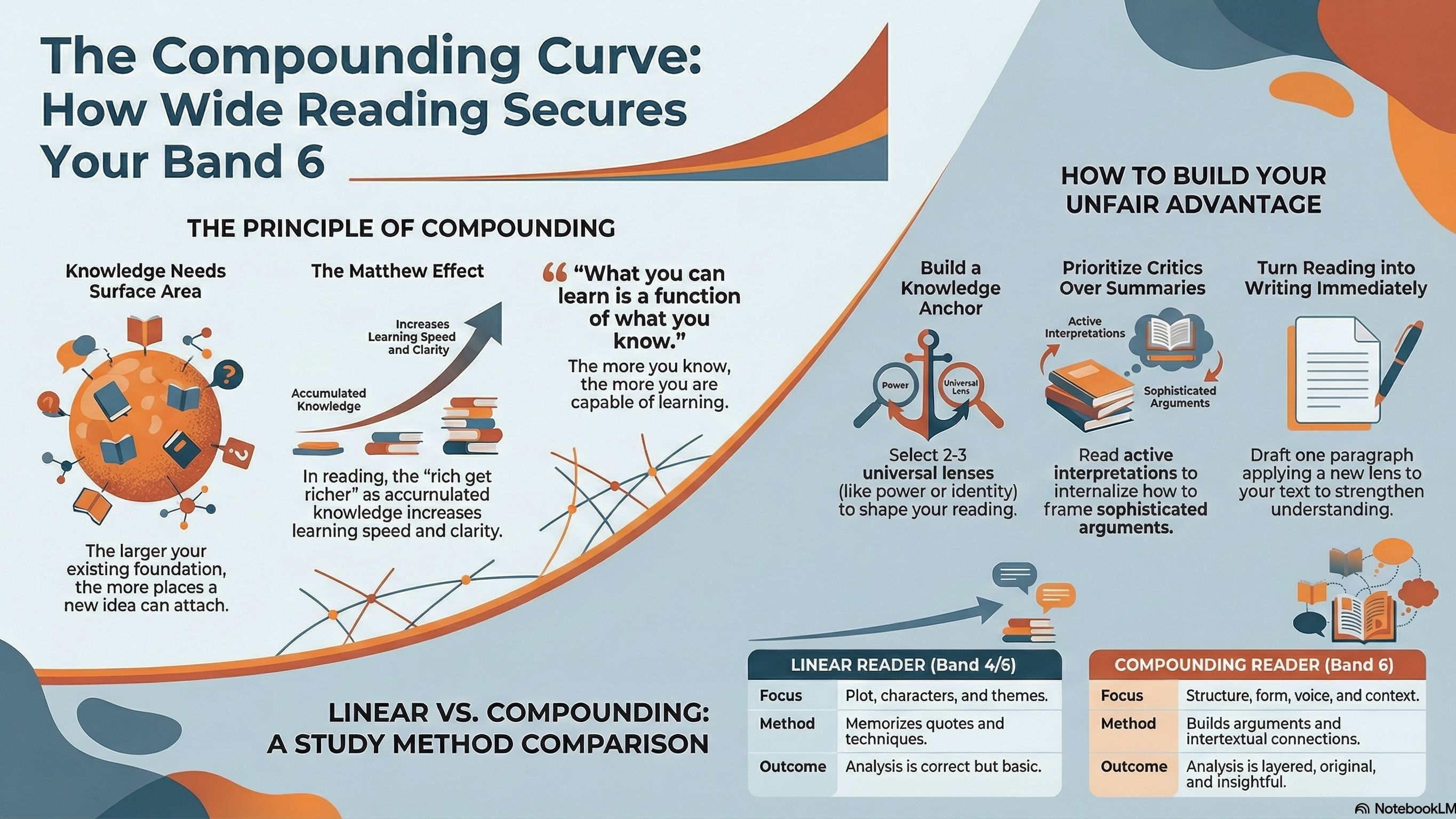
Want to write a Band 6 essay? Your prescribed text alone cannot get you there.
At face value this doesn't sound awfully profound.
But stop.
Think about it.
Why can't one text studied deeply be enough? What are the top students doing differently? And why does everyone keep telling you to "read more" without explaining why?
The Principle of Compounding Knowledge
If two people read the same thing, the person with the larger knowledge base will learn more.
What you're capable of learning depends entirely on what you already know. Every new idea is constrained or expanded by the foundation already in place.
That's because information is relational. A single fact on its own is fragile. But once it connects to something else (an image from another poem, a concept from history, even a conversation you've had) it becomes stronger, more memorable, easier to use.
Think of it like this: knowledge needs surface area to stick to. The larger your existing foundation, the more places a new idea can attach. The more connections it makes, the deeper it embeds. The deeper it embeds, the easier it becomes to use.
This is why rereading feels different. When you return to a novel five years later, you aren't just revisiting the book. You're revisiting it with everything else you've learned in between. Each new experience, each new text, compounds the meaning of the old one.
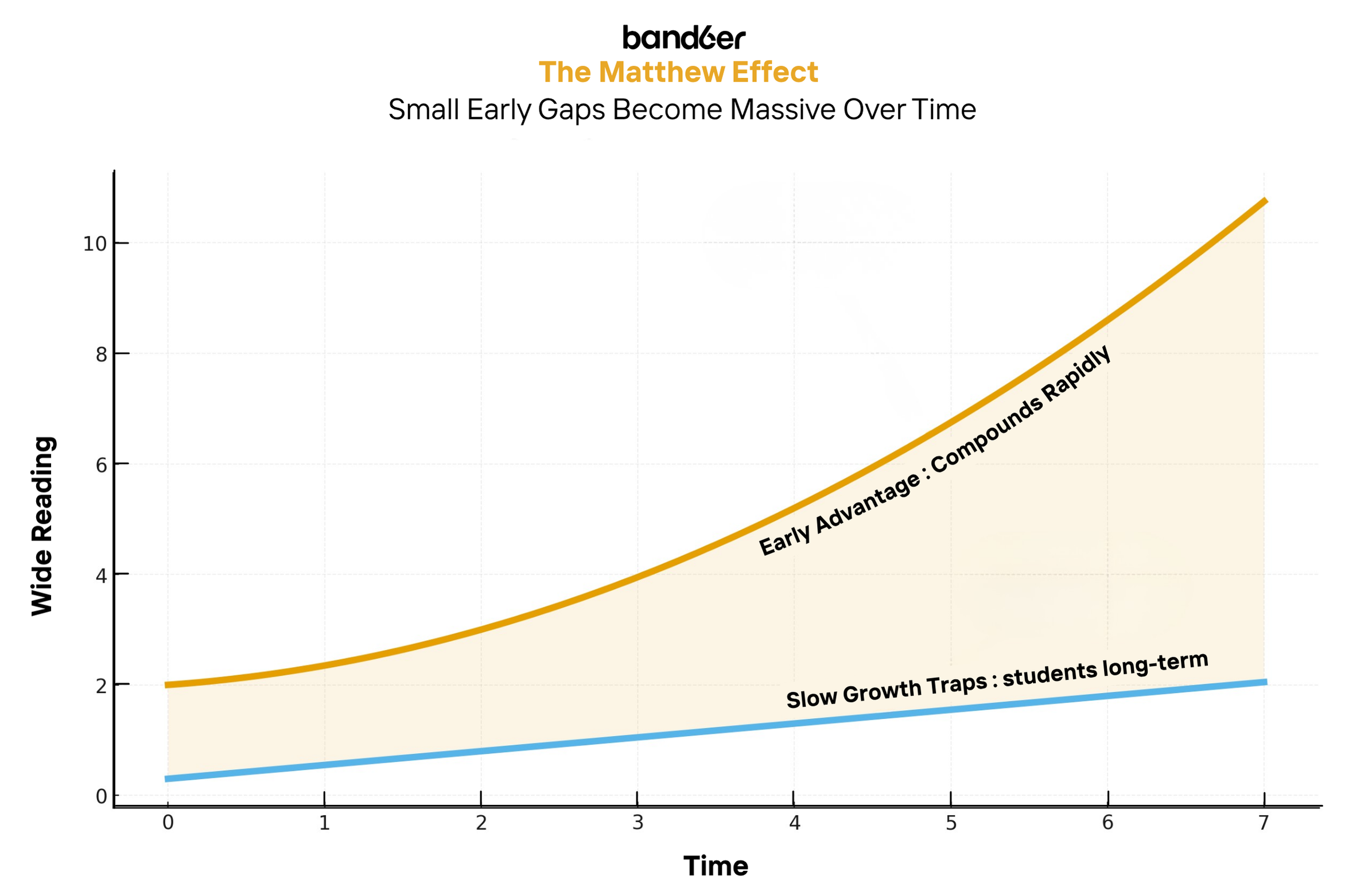
Sociologists call this the Matthew Effect: the rich get richer. In the realm of reading, it means that those who read widely gain the hidden advantage of speed, clarity, and originality.
"The advantage tends to accumulate." -Robert K. Merton, The Matthew Effect in Science, 1968
Duncan Anderson articulates this masterfully:
"What you can learn is a function of what you know. The more you know the more you can learn.
What you can do is a function of what you have done. The more you have done, the more you can do."
The Student Advantage
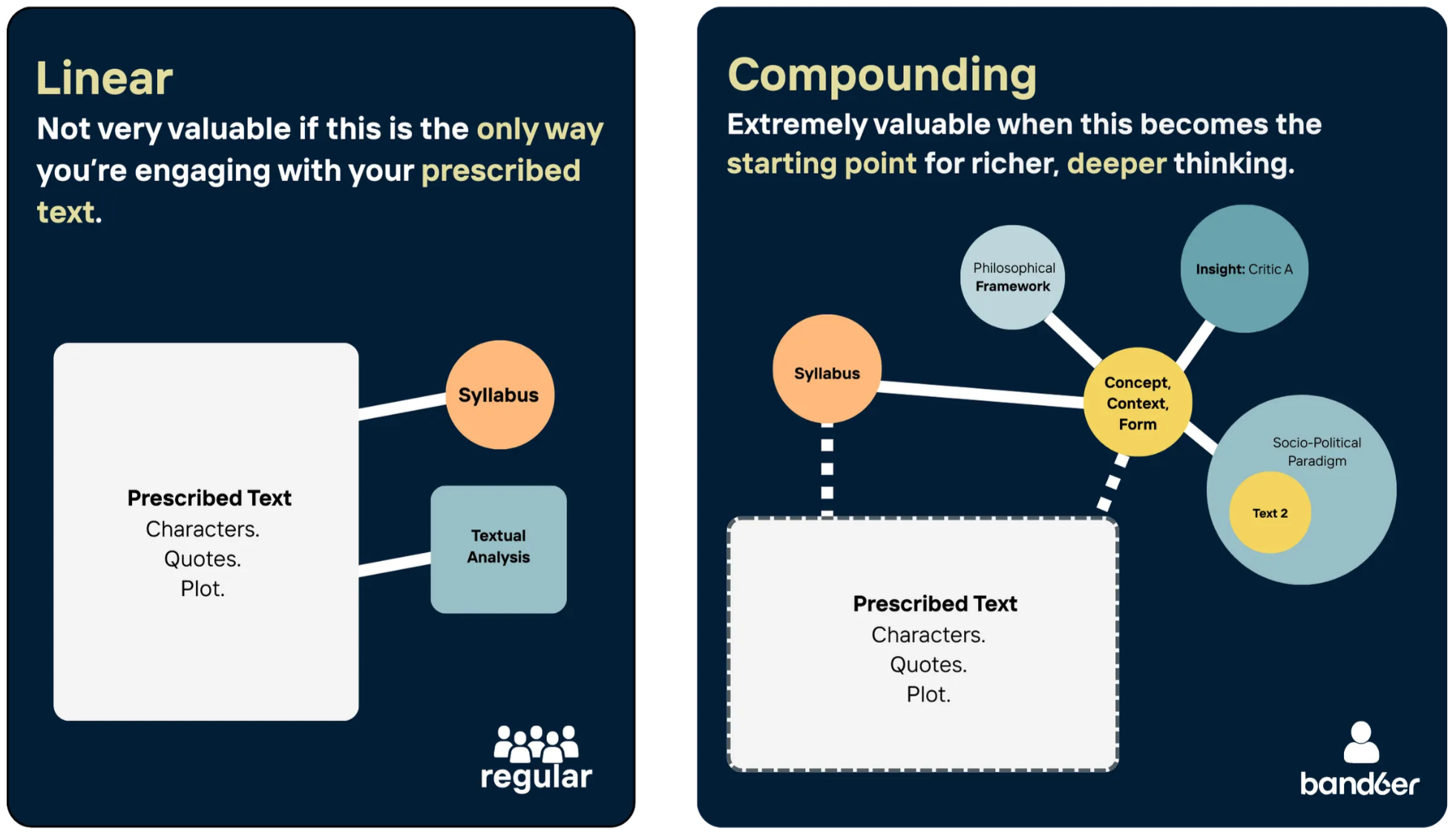
Why does this matter for you? Because most students only ever read the minimum: the prescribed text. Memorise quotes. Drill techniques. Write practice essays. And their analysis still sounds like everyone else's.
That’s a linear approach.
You're all reading the same thing. So you're all thinking the same thoughts.
Wide readers compound. They:
- Have instant comparisons (they've seen this pattern in five other texts)
- Recognise techniques quickly (they know what's typical and what's unique)
- Make connections nobody else can (they bring contexts from outside the syllabus)
This is the hidden advantage in HSC English. Not intelligence. Not memorisation. Compounding.
The HSC doesn't reward students who know their prescribed text best.
It rewards students who can use their prescribed text to demonstrate sophisticated thinking.
And you can't think sophisticatedly about something you've only seen once. You need reference points. Comparisons. Frameworks. Context.
That's what wide reading gives you. Not more knowledge about your text. More knowledge around it.
And that's what creates depth, originality, confidence
| Hard-Working Linear Reader | Hard-Working Compounding Reader |
| Prepares using summaries and class notes. Knowledge base = empty shelf. Approaches the text as something entirely new. | Enters the text with pre-built lenses Knowledge base = prior frameworks + critics. Text feels familiar (“I’ve seen this pattern before”). |
| Focuses on plot, characters, themes. Reads to understand “what is happening.” | Sees structure, form, voice, context, intertextual echoes. Reads to understand “what the text is doing and why.” |
| Memorises quotes + techniques. Rewrites essays but ideas don’t deepen. Analysis is correct but basic. | Builds arguments, Adds new connections each week → deeper interpretation. Analysis becomes layered, original, insightful. |
| Vulnerable to unfamiliar questions. Band 4/5. | Thrives under variation. Band 6. |
How to Start Compounding Now
- Build a Knowledge Anchor. Select two or three universal critical lenses (like power, identity, memory, gender, or morality) that genuinely interest you and suit your texts. Read widely around these lenses to understand their nuances. Over time, these anchors shape how you read, think, and write, giving your analysis a clear intellectual centre.
- Read critics, not summaries of your text. Prioritise essays, reviews, and critical commentary — forms where someone is actively interpreting a text Critics model the analytical moves you want to internalise: how to frame an argument and draw broader connections. Their thinking becomes a template for your own.
- Read short, dense things regularly. Critical essays, opinion pieces, one chapter from theory. These are easier to finish, easier to revisit, and give you high-quality inputs without the commitment of a full book.
- Turn reading into writing immediately. After you read something, write one topic sentence using that idea. Or draft one paragraph applying that lens to your prescribed text. Output strengthens understanding faster than rereading ever will.
👉 The Rule Of Thumb: Wide reading isn't about finishing a stack books. It's about exposure. 10 minutes a day. Every bit of context, critical voices and perspectives you gather makes your prescribed text richer.
Wide reading isn’t extra work. It’s exponential work. The more you read, the more you can read. The more you know, the faster you’ll know.
That’s the Compounding Curve of Reading, and in HSC English, it’s the curve that separates Band 6 from the rest.
Start small. Stay consistent. Invest in a knowledge base that will stay with you long after you earn that Band 6.