
How to Develop a Sophisticated Essay Voice
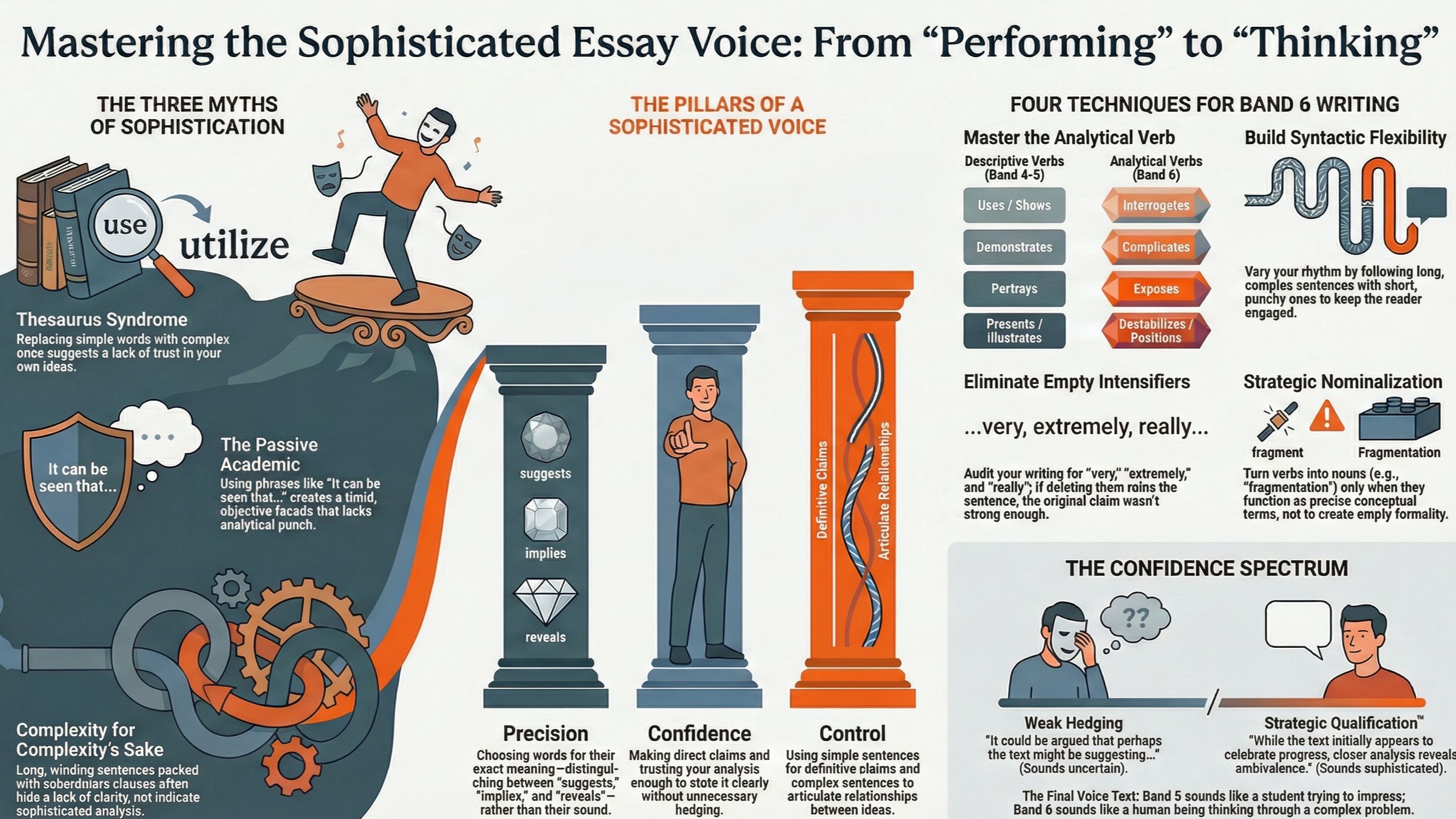
Your essay voice is about how you think on the page.
Most students confuse sophisticated writing with formal writing. They believe Band 6 means longer words, more complex syntax, elevated diction. So they write sentences like: "The composer utilizes sophisticated literary mechanisms to facilitate the exploration of multifaceted thematic concerns."
Markers don't reward this. They skim past it looking for actual thought.
Here's what sophisticated voice actually means: the ability to handle complex ideas with precision and clarity.
What Most Students Get Wrong About Voice
The three false markers of sophistication:
- Thesaurus Syndrome: Replacing simple words with complicated ones. "Utilize" instead of "use." "Facilitate" instead of "help." "Multifaceted" instead of "complex." This doesn't sound smart. It sounds like you don't trust your ideas.
- The Passive Academic: Believing formality means removing yourself from the analysis. "It can be seen that…" "It is evident that…" "One might argue…" This doesn't sound objective. It sounds timid.
- Complexity for Complexity's Sake: Writing long, winding sentences packed with subordinate clauses because you think sophisticated analysis requires sophisticated syntax. It doesn't. It requires sophisticated thinking expressed clearly.
All three mistakes share the same root cause: you're performing sophistication instead of embodying it.
What Sophisticated Voice Actually Sounds Like
Sophisticated voice has three characteristics that work together.
Precision: You choose words because they mean exactly what you need them to mean, not because they sound impressive. You distinguish between "suggests," "implies," and "reveals" because these are different analytical claims.
Confidence: You make claims directly. You don't hedge unnecessarily. You trust your analysis enough to state it clearly.
Control: Your sentences do what you need them to do. Simple sentences for clear claims. Complex sentences when showing relationships between ideas. You choose syntax based on analytical function, not aesthetic preference.
The voice test: Read your essay aloud. Does it sound like a human being thinking through a complex problem? Or does it sound like someone performing what they think academic writing should be?
Band 5: Sounds like a student trying to impress a marker.
Band 6: Sounds like a thinker working through an interesting question.
Four Techniques That Actually Build Sophistication
1. Master the Analytical Verb
The verbs you choose reveal your level of thinking.
Descriptive verbs (Band 4-5): uses, shows, demonstrates, portrays, presents, illustrates
These verbs describe what texts contain or what authors do. They produce sentences like: "Shakespeare uses imagery to show power."
Analytical verbs (Band 6): interrogates, complicates, exposes, destabilizes, positions, enacts
These verbs make claims about how texts examine ideas. They produce sentences like: "Shakespeare's imagery interrogates the relationship between natural order and political legitimacy."
The difference? Analytical verbs force you to think about what texts do to ideas, not just what they contain.
Practice this: Take any sentence in your essay that uses "shows" or "demonstrates." Replace it with an analytical verb. If the sentence doesn't make sense anymore, your original claim wasn't sophisticated enough. Rewrite the entire claim, not just the verb.
2. Build Syntactic Flexibility
Sophisticated writers vary sentence structure based on what each sentence needs to accomplish.
Use simple sentences for clear, definitive claims:
Short sentences create emphasis. They stop readers in their tracks. They signal: this matters, pay attention.
Use complex sentences to show relationships between ideas:
"While the surface narrative celebrates individual agency, the text's formal structure reveals how choice itself operates within predetermined ideological boundaries."
Complex sentences demonstrate complex thinking. They show you can hold multiple ideas simultaneously and articulate how they relate.
The rhythm test: Read your paragraph aloud. Do all your sentences sound the same length and structure? If yes, you're not using syntax strategically.
Alternate deliberately. Follow a long, complex sentence with a short one. The contrast creates rhythm and keeps readers engaged.
3. Eliminate Empty Intensifiers
Words like "very," "extremely," "highly," "quite," and "really" don't add sophistication. They dilute it.
Instead of: "The imagery is very powerful and creates an extremely disturbing atmosphere."
Try: "The imagery destabilizes pastoral conventions, replacing natural harmony with visceral decay."
The second version is more sophisticated not because it uses bigger words but because it makes a specific, provable claim. "Destabilizes pastoral conventions" does analytical work. "Very powerful" does nothing.
Intensifier audit: Search your essay for "very," "really," "extremely," "quite," "highly," "somewhat." Delete each one. If the sentence loses meaning, you weren't making a strong enough claim. Rewrite it.
4. Practice Nominalisation Strategically
Nominalisation turns verbs and adjectives into nouns (transform → transformation, resist → resistance). Used well, it creates conceptual density. Used poorly, it kills your prose.
Good nominalisation (creates precision):
"The speaker's fragmentation mirrors the text's formal disintegration."
Here, "fragmentation" and "disintegration" function as precise conceptual terms. They let you talk about processes as things you can analyze.
Bad nominalisation (creates abstraction):
"The utilization of symbolic representation facilitates the communication of thematic exploration."
This doesn't mean anything specific. It's empty formality.
The clarity test: If you can replace a nominalised phrase with a simple verb construction without losing meaning, do it. Only keep nominalisations that create genuine conceptual precision.
The Confidence Spectrum: How to Make Claims Directly
Sophisticated voice doesn't mean absolute certainty about everything. It means knowing when to hedge and when to assert.
Weak hedging (undercuts your analysis):
"It could be argued that perhaps the text might be suggesting…"
"One might potentially interpret this as possibly indicating…"
This doesn't sound careful. It sounds like you don't believe your own reading.
Strategic qualification (acknowledges interpretive complexity):
"While the text initially appears to celebrate progress, closer analysis reveals ambivalence."
"The ending resists singular interpretation, offering neither complete redemption nor total collapse."
This sounds like sophisticated thinking. You're not uncertain; you're precise about the nature of textual complexity.
The Three-Level Voice Comparison
Same textual evidence (Frankenstein's creature learning to read), three different voice levels:
Band 4-5 voice:
"The creature learns to read and this shows he wants to be part of society. Mary Shelley uses this to demonstrate that the creature is not actually evil but just wants acceptance. This is very important to the themes of the novel."
Problems: Vague verbs ("shows," "demonstrate"), empty intensifiers ("very important"), describes content rather than analyzing ideas.
Band 5-6 voice:
"The creature's acquisition of literacy represents his desire for social integration. Through his self-education, Shelley explores the relationship between knowledge and belonging, suggesting that the creature's monstrosity is socially constructed rather than inherent. This complicates simplistic readings of the creature as purely villainous."
Better: More precise language, starts engaging with ideas, but still somewhat safe and descriptive.
Band 6 voice:
"Literacy promises the creature entry into human society but instead renders his exclusion absolute. The texts he reads (Paradise Lost, Plutarch, Goethe) teach him the language of civilization while simultaneously revealing civilization's refusal to recognize him within it. Knowledge here doesn't liberate; it clarifies the permanence of his isolation."
Why this works: Direct claims, analytical verbs ("renders," "revealing," "clarifies"), handles paradox sophistication (literacy as both promise and prison), syntactic variety, conceptual precision.