
Stop Announcing Your Quotes: The Art of Seamless Evidence Integration
For Band 6 (18-20/20), every single English Advanced assessment rubric includes language about "skillfully communicates" or "skillfully integrates textual references."
Not just "communicates." Skillfully.
And one of the clearest ways markers identify skilful communication is how you integrate evidence. Do your quotes flow naturally within sophisticated sentences? Or do you stop, announce them, then explain them?
Both approaches include evidence. Only one demonstrates the refined language control that criteria explicitly reward.
What the Criteria Actually Say
Look at any NSW English Advanced assessment criteria for the top band:
- "Skilfully integrates a range of relevant textual references"
- "Demonstrates skilful communication through refined use of language"
- "Skilfully uses language forms and features to communicate ideas"
When markers read 100+ essays, they're looking for writing that flows, that feels controlled, that integrates sources intensionally.
How to Integrate Evidence Seamlessly
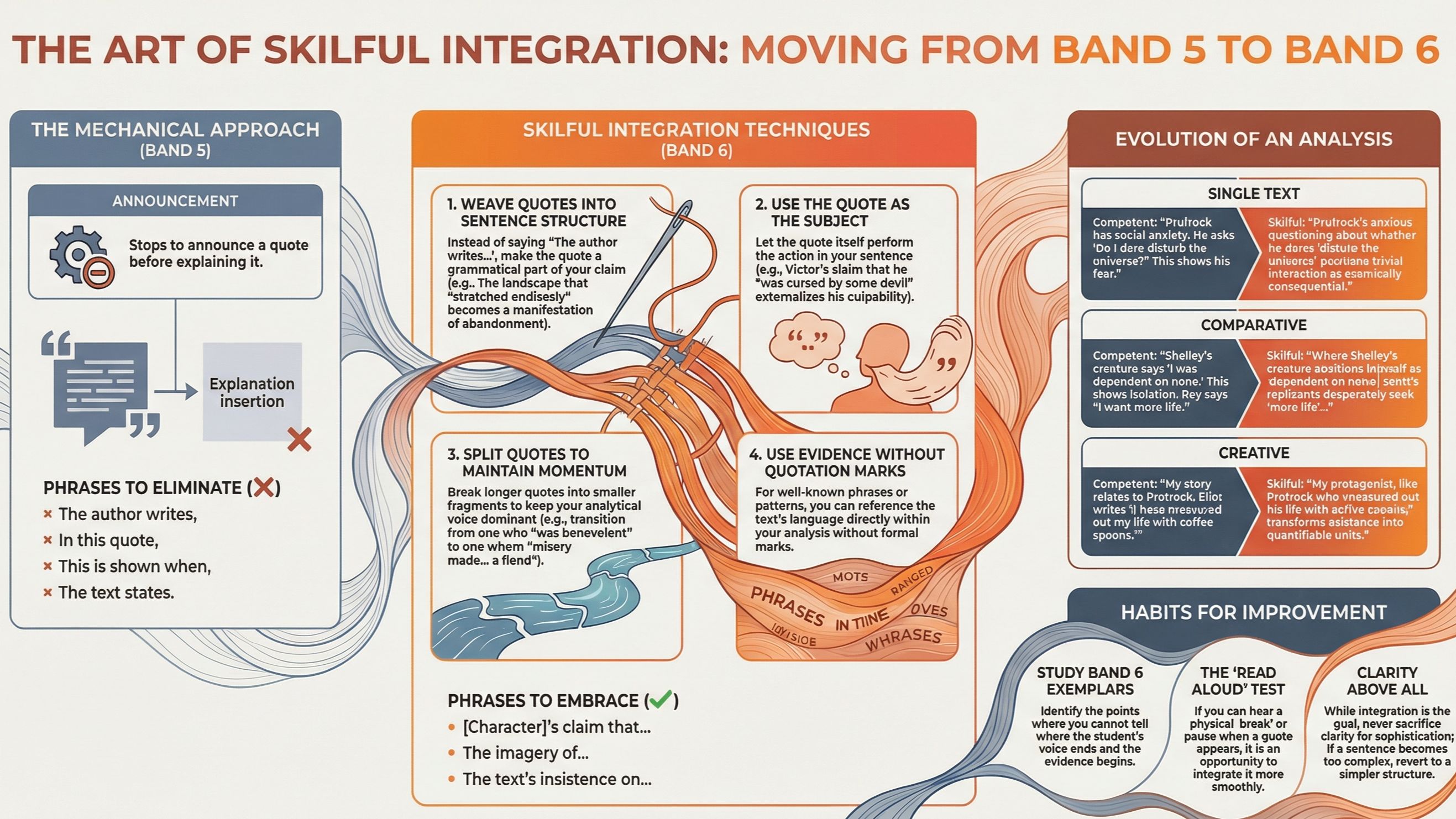
Technique 1: Make the Quote Part of Your Sentence Structure
Bad: The author writes "the desolate landscape stretched endlessly." This shows isolation.
Good: The landscape that "stretched endlessly" in its desolation becomes a spatial manifestation of psychological abandonment.
See the difference? The quote isn't announced. It's woven into the grammatical structure of your analytical claim.
Technique 2: Use the Quote as the Subject
Bad: In this part, Victor says "I was cursed by some devil." This shows he avoids responsibility.
Good: Victor's claim that he "was cursed by some devil" externalizes culpability, transforming deliberate choice into supernatural victimization.
The quote itself becomes the actor in your sentence. You're not pointing to it from outside. You're working from within it.
Technique 3: Split Quotes to Maintain Flow
Bad: The creature describes his experience: "I was benevolent and good; misery made me a fiend."
Good: The creature's transformation from one who "was benevolent and good" to one whom "misery made...a fiend" locates monstrosity not in nature but in social construction.
By breaking the quote and embedding pieces where they support your analysis, you maintain momentum while still proving your point.
Technique 4: Use Evidence Without Quotation Marks (When Appropriate)
Good: When the creature positions himself as dependent on none and related to none, the parallelism creates an ontological void where independence should exist.
Sometimes you can reference the text's language without direct quotation, especially for well-known phrases or when you're analyzing the pattern rather than exact words.
Phrases to Eliminate
These signal isolated, mechanical evidence use:
❌ "The author writes..."
❌ "In this quote..."
❌ "This is shown when..."
❌ "The text states..."
❌ "For example, [character] says..."
These allow seamless integration:
✅ [Character]'s claim that "..."
✅ The imagery of "..." positions...
✅ When [character] describes himself as "..."
✅ The text's insistence on "..."
What This Looks Like Across Forms
Single Text Analysis
Competent: Prufrock has social anxiety. He asks "Do I dare disturb the universe?" This rhetorical question shows his fear of social action. Even small interactions feel cosmically important to him. This demonstrates modernist alienation.
Skilful: Prufrock's anxious questioning about whether he dares "disturb the universe" positions trivial social interaction as cosmically consequential, the rhetorical hyperbole itself performing modernist alienation where individual agency carries impossible metaphysical weight.
Comparative Essays
Competent: Shelley's creature says "I was dependent on none." This shows isolation. In Blade Runner, replicants want connection. Roy says "I want more life." The texts show opposite approaches to relationships and consciousness.
Skilful: Where Shelley's creature positions himself as "dependent on none," Scott's replicants desperately seek "more life" and human connection, the inverted isolation/companionship dynamic revealing different cultural anxieties about consciousness, autonomy, and the price of sentience.
Creative Responses
Competent: My story relates to Prufrock. Eliot writes "I have measured out my life with coffee spoons." I used this concept of quantifying life in my character's behavior.
Skilful: My protagonist, like Eliot's Prufrock who "measured out his life with coffee spoons," transforms existence into quantifiable units to avoid genuine experience, each calculated gesture a defense against the vulnerability of feeling.
How to Build This Skill
1. Study Band 6 exemplars
Notice how often you can't tell where evidence begins. That seamlessness is what you're building toward.
2. Rewrite practice paragraphs
Take functional paragraphs and practice integrating evidence more smoothly. Compare which version flows better.
3. Read your work aloud
Can you hear the breaks where quotes appear? Those are opportunities to integrate more skilfully.
4. Don't force it under pressure
In exams, if integration makes a sentence unclear, use clearer structure. Clarity always comes first. But aim for integration when you can.
The Bottom Line
"Skilfully integrates textual references" isn't subjective. It's in every rubric for the top band.
Markers can tell the difference between:
- Evidence presented mechanically (Band 5 range)
- Evidence woven naturally into sophisticated analysis (Band 6 range)