
The 16/20 Curse: Top 6 Ways Students Miss Band 6 in HSC English Advanced
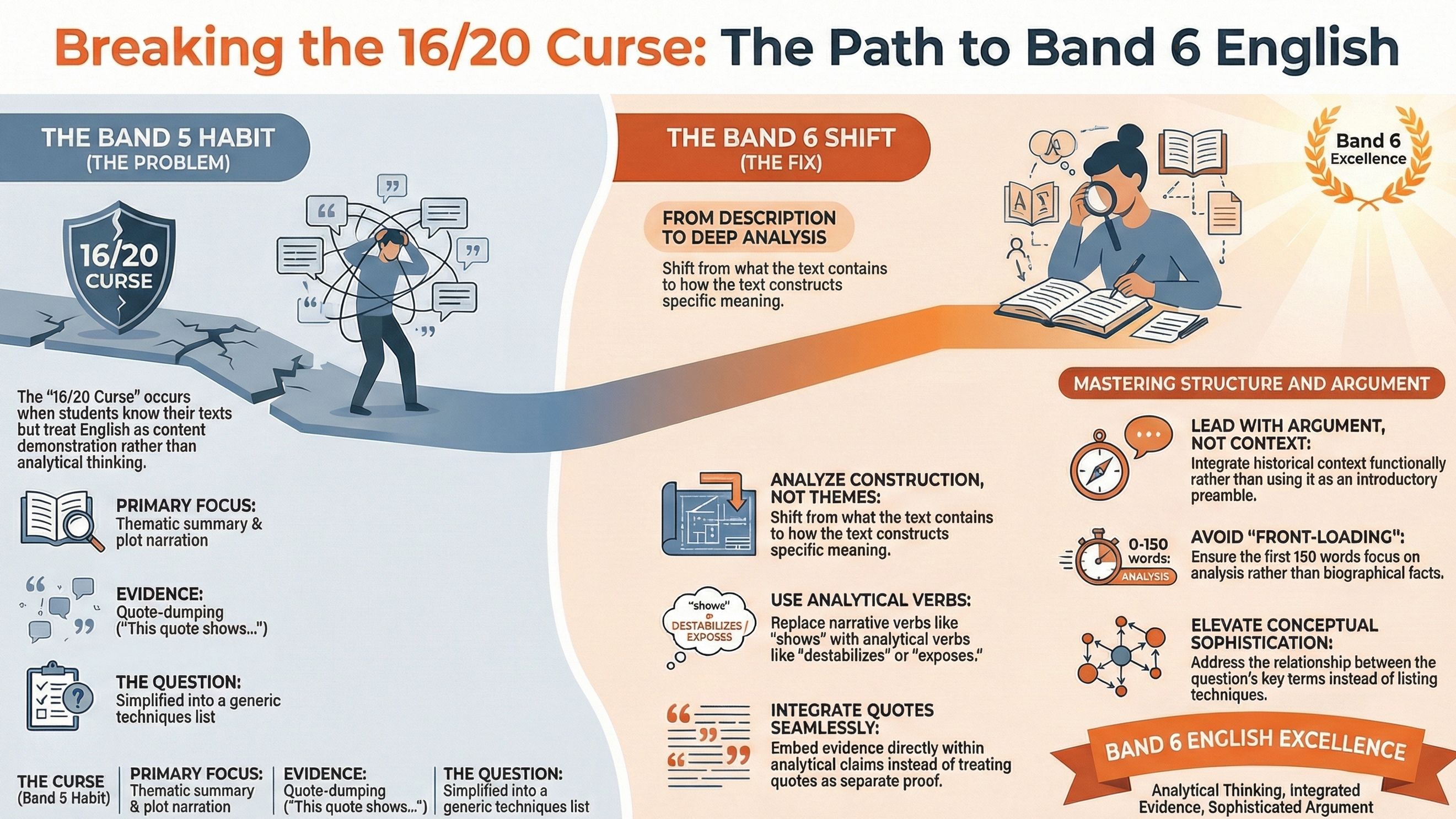
You write brilliant practice essays. Your teacher gives you consistent Band 5s. You know your texts inside out. Then HSC results arrive, and you're still in Band 5.
Not because you failed. Because you made specific, systematic mistakes that kept you just below the Band 6 threshold. Here are the six most common errors and how to fix them.
1. You Write About Themes Instead of Textual Construction
What it looks like: "Frankenstein explores the theme of ambition and its consequences. Shelley shows how Victor's desire for knowledge leads to his downfall."
Why it caps you: This is thematic summary, not textual analysis. You're discussing ideas the text contains rather than how the text constructs meaning.
The diagnostic: If you can swap your text's name with another text and the sentence still works, you're writing about themes. "Frankenstein explores ambition" works just as well as "Macbeth explores ambition."
The fix: Anchor every claim to specific textual mechanics. Not "Shelley explores ambition" but "Shelley's fragmentation of Victor's narrative across embedded perspectives mirrors his fractured identity, positioning ambition as destabilizing to coherent selfhood."
2. …
3. You Describe What Happens Instead of Analyzing How Meaning Is Made
What it looks like: "Richard manipulates Lady Anne using persuasive language. He convinces her to accept his ring. This shows his skill at deception."
Why it caps you: This is plot summary with labels added. You're narrating events, not analyzing textual mechanics.
The diagnostic: Check your verbs. Are you using narrative verbs (shows, demonstrates, convinces) or analytical verbs (destabilizes, complicates, undermines, exposes)? Narrative verbs indicate description.
The fix: Analyze what the text does, not what characters do. Not "Richard manipulates Anne" but "Shakespeare's compression of Anne's capitulation into rhythmic couplets disrupts dramatic realism, exposing seduction as theatrical performance rather than psychological event."
4. You Quote-Dump Instead of Building Integrated Analysis
What it looks like: "Wordsworth's connection to nature is evident in the quote 'a presence that disturbs me.' This shows his spiritual connection. Another quote that demonstrates this is 'lover of meadows and mountains.'"
Why it caps you: Quotes sit separately from your argument instead of integrating into it. You're treating evidence as proof rather than as substance requiring analysis.
The diagnostic: Count your uses of "This quote shows" or "This is evident in." More than once per essay means you're quote-dumping.
The fix: Embed quotes within analytical claims. Not "Wordsworth feels connected, as seen in 'a presence that disturbs me'" but "Wordsworth's paradoxical construction of presence as 'disturbing' disrupts Romantic nature-as-comfort conventions, positioning transcendence as unsettling to ordinary consciousness."
5. You Front-Load Context Instead of Leading With Argument
What it looks like: "Written in 1818 during the Romantic period, Mary Shelley's Frankenstein reflects Industrial Revolution anxieties. Shelley was influenced by Percy Shelley and Byron. The novel emerged from a ghost story competition..."
Why it caps you: You've used 20% of your word count on context before reaching actual analysis. Band 6 responses integrate context functionally, not as obligatory preamble.
The diagnostic: Check your first 150 words. If more than 30 words are dates, biographical facts, or historical background, you're front-loading.
The fix: Start with textual analysis. Not "During the Romantic period, Shelley..." but "Shelley's embedding of Walton's, Victor's, and the creature's perspectives fractures Romantic autobiography's coherent subject, suggesting identity formation requires contradictory accounts."
6. You Simplify the Question's Conceptual Sophistication
What it looks like:
Question: "How does your text use form to challenge readers' assumptions about representation?"
Your response: "The text challenges assumptions through various techniques like symbolism and narrative structure..."
Why it caps you: You've converted a sophisticated conceptual question into a generic techniques list. The question asks about the relationship between form and challenged assumptions. You're listing techniques without addressing why challenging assumptions matters or how form enables it.
The diagnostic: Underline the key conceptual terms in the question. If your thesis doesn't explicitly address the relationship between these terms, you've simplified it.
The fix: Treat the question as an argument to develop, not a topic to address. "By fragmenting temporal sequence across non-linear episodes, the text forces readers to construct causality actively, exposing representation as interpretive process rather than transparent reflection."
The Pattern
These aren't six random errors. They're six versions of the same problem: treating English as content demonstration rather than analytical thinking. Band 5 students prove they've read the text. Band 6 students prove they can analyze how texts create meaning.
The gap isn't about more sophisticated sentences or better quotes. It's about shifting from "I can identify techniques" to "I can analyze how techniques function to construct meaning."
These six errors are diagnostic markers. Once you identify them in your writing, you can fix them. And once you fix them consistently, you're writing at Band 6 standard.