
The First 15 Words: Why Your Topic Sentence Determines Your Band
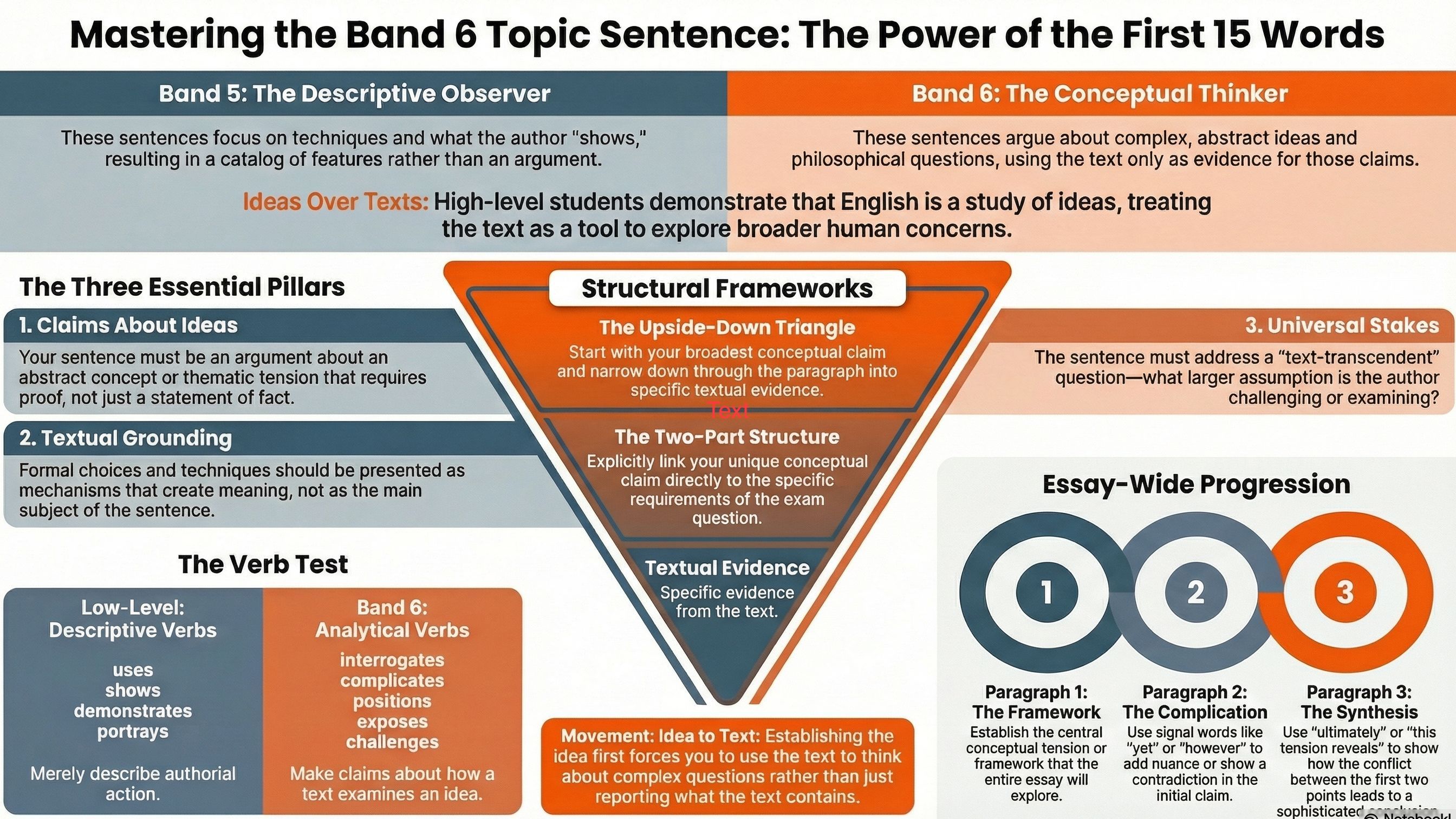
A topic sentence is your paragraph's mini-thesis. It determines the scope, direction, and analytical level of everything that follows.
Here's what most students get wrong: they think a topic sentence just "introduces what the paragraph is about."
What markers actually assess in your opening line:
- Is this student making a claim about ideas or describing textual features?
- Will this paragraph analyze meaning or catalog techniques?
- Is this student thinking conceptually or just observing?
Your topic sentence reveals your thinking level before you've written a word of evidence.
Band ≤5 topic sentences promise: "I will show you what techniques the author uses and explain what they represent."
Band 6 topic sentences promise: "I will argue about complex ideas, using the text as evidence for my claims."
The Band 6 student has already demonstrated they understand that English is about ideas, not texts.
Text-Based vs Conceptual: Two Valid Approaches
Text-based topic sentences ground claims in specific textual details first, then build toward conceptual significance. Movement: text to idea.
Conceptual topic sentences establish text-transcendent ideas first, then show how the text explores them. Movement: idea to text.
Both can reach Band 6. The distinction is strategic, not qualitative.
The advantage of conceptual-first openings? They force you to identify the idea before hunting for evidence. This aligns with actual literary analysis: using texts to think about complex questions, not reporting what texts contain.
Critical insight: whether you start with concept or text, your topic sentence must make a claim about ideas that requires argumentative proof. If techniques identification alone proves your point, you're describing, not analyzing.
Three Essential Components of Band 6 Topic Sentences
1. A claim about ideas, not textual content
Argue about abstract concepts, philosophical questions, thematic tensions. Make claims that could be true or false, requiring interpretation and evidence. Describing what happens or what techniques exist = observation. What you need = argument.
2. Textual grounding that serves the claim
Techniques and formal choices are mechanisms through which texts create meaning. They're not the point itself. Show how textual strategies create meaning, not just that they exist.
3. Stakes that transcend the text
What larger question is the text examining? What assumptions is it challenging? Literature exists to think about complex ideas, not just tell stories.
Two Structural Frameworks
The two-part structure: Conceptual claim + question connection. Your analytical idea about the text, explicitly tied to what the question asks.
The upside-down triangle: Start with your broadest conceptual claim. Each subsequent sentence narrows down, getting more textually specific. By your concluding sentence, you've proven your broad opening through specific evidence. Move from idea to evidence, never from observation to attempted meaning.
The verb test: "Uses," "shows," "demonstrates," "portrays" describe authorial action. "Interrogates," "complicates," "positions," "exposes" make claims about how texts examine ideas.
Building Across Your Essay: Three-Paragraph Progression
Individual strong topic sentences are necessary but insufficient. Your topic sentences must create a developing argument.
Paragraph 1: Establish your conceptual framework. Introduce the central tension, question, or idea your essay will explore.
Paragraph 2: Complicate that framework. Add nuance, contradiction, or alternative perspectives that deepen your initial claim. Signal words: "yet," "however," "while."
Paragraph 3: Synthesize. Show how the tension between your first two claims leads to sophisticated understanding. Signal words: "ultimately," "therefore," "this tension reveals."
When markers read your topic sentences in sequence, they should follow your thought process without reading supporting evidence. Your topic sentences should reveal a mind working through challenging questions, not making three separate observations.
Final Checklist
✓ Claims ideas, not textual content
✓ Uses text as evidence, not subject
✓ Questions/examines rather than describes
✓ Creates argument requiring proof
✓ Establishes stakes beyond plot
✓ Specific enough to require this particular text
✓ Sophisticated enough that technique identification alone won't prove it
✓ Actually answers the exam question
Your Band 6 starts in the first 15 words. Make them count.