
The "Hidden Third Exam": Why Your Reading Time Determines Your Band
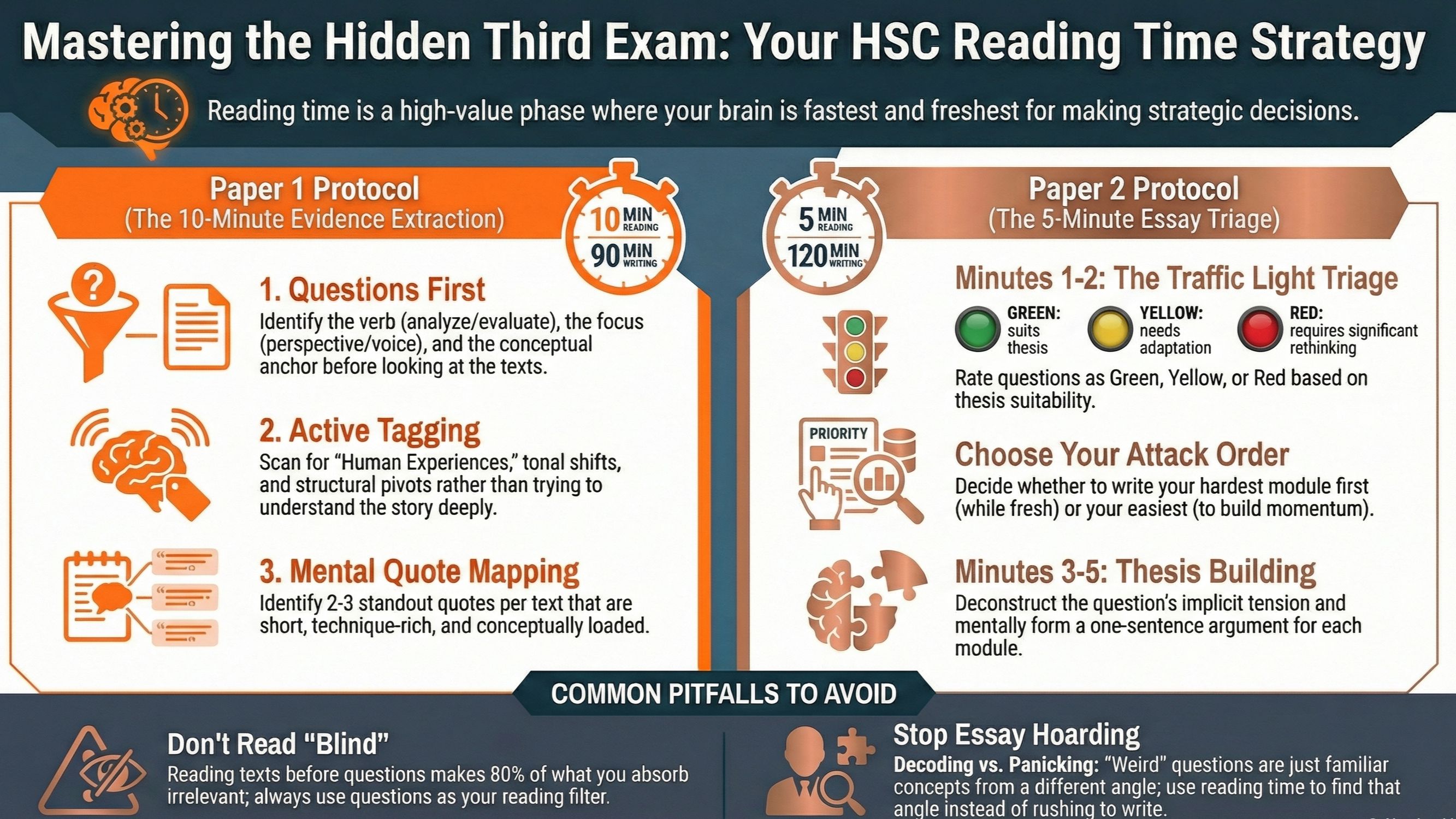
You know about Paper 1. You know about Paper 2. But there's a third exam happening before you even pick up your pen, and most students are failing it without realizing. Reading time is not a chance to calm your nerves or skim the questions. It's a vital component of your exam, and the students who understand this walk out with different marks than the ones who don't.
While everyone else is passively absorbing words, you should be MENTALLY extracting, analysing, and making strategic decisions that lock in your Band 6 before working time even begins.
The Numbers You're Working With
Paper 1 (Unseen Texts - Common Module)
- Reading time: 10 minutes
- Working time: 1 hour 30 minutes
Paper 2 (Modules A, B, C)
- Reading time: 5 minutes
- Working time: 2 hours
The HSC gives you reading time because your brain is fastest when you are calm, fresh, and not yet writing. These early minutes are your highest-value minutes. They determine:
- what evidence you will use
- the order you will answer
- how clearly you will write
- how confident you will feel
But here's what students do: they waste Paper 1's reading time worrying about the thing they already know (their essay) instead of the thing they're seeing for the first time (the unseen texts).
It's backwards. And it's killing your marks.
What You're Actually Doing Wrong
You're reading texts before reading questions.
When you read blind, you're absorbing everything equally. Details about setting, character names, historical context, none of it filtered. Then you hit the question and realize 80% of what you just read is irrelevant.
Questions are reading filters. They tell you what matters. Read them first, always.
You're panicking over "weird" questions instead of decoding them.
Every HSC question is answerable with what you've studied. If it looks strange, it's asking about something you know from a different angle. The students who take the full five minutes to decode it find the angle. The students who panic and start writing immediately... don't.
You're making zero strategic decisions.
Reading time is decision time. Which module should I write first? Which examples support this question best? What's my thesis angle? If you're not deciding during reading time, you're deciding while writing, which means slower execution and weaker responses.
You're "understanding" the unseen text instead of mapping it.
You don't need deep comprehension. You need technique locations. Where are the imagery clusters? What's the tonal shift? Which 10-15 words are most quotable? Think like you're tagging evidence, not reading for pleasure.
You're worried about forgetting your essay.
You won't forget your essay. You've written it twenty times. You will forget the specific syntactic detail in Text B that perfectly answers Question 2 if you don't process it now, while it's in front of you.
Paper 1: Your Ten-Minute Evidence Extraction Protocol
Questions first, always.
Read every question before touching the texts. Identify the verb (explain, analyse, evaluate), the textual focus (imagery, perspective, voice), and the conceptual anchor (identity, fracture, memory).
This becomes your reading lens. You're not reading everything. You're reading for this.
Active tagging, not passive reading.
As you scan each text, mentally flag:
- The human experience being explored (loss, power, belonging, change)
- The controlling idea (what's this text actually saying?)
- Structural pivots (where does tone shift? That's where meaning deepens)
- Imagery patterns (what images repeat? How do they connect to the question?)
- Two or three standout quotes (technique-rich, conceptually loaded, short enough to remember)
You're not trying to understand the text deeply. You're trying to extract what you need to answer the question in front of you.
Paper 2: Five Minutes to Lock in Three Essays
Paper 2's shorter reading time reflects a different reality: you already know your texts. The only variable is the question.
Minutes 1-2: Triage everything.
Read all three questions immediately. Assign each a mental difficulty rating:
- Green: This question suits my prepared thesis perfectly
- Yellow: I can adapt my ideas to this
- Red: This is going to require significant rethinking
Then decide: what order will you write them in?
Most students write in order ( A → B → C). Consider:
- Writing your hardest module first while you're sharpest
- Writing your easiest module first to build confidence and momentum
- Writing your strongest module first to secure your best essay before fatigue hits
Know yourself. Know your strategy. Test it in practice papers before you walk into that room.
Minutes 3-5: Build three theses.
For each question, identify:
- The verb (evaluate vs. explore vs. examine = different structures)
- The focus (are they asking about texts? Contexts? Values? Human experiences?)
- The angle (what's the implicit tension in this question?)
Then form your thesis. Not your entire introduction. Just your one-sentence argument that directly answers what they're asking.
The Bottom Line
Reading time is the hidden third exam. The students who treat it seriously enter working time with clarity, structure, and locked-in evidence. The students who waste it spend their working time re-reading, second-guessing, and producing weaker responses under pressure.
Paper 1's ten minutes exist because unseen texts require active processing.
Paper 2's five minutes exist because question deconstruction determines essay quality.
Stop treating reading time like a warm-up. Start treating it like the scored exam component it actually is.
And stop guessing what works for you. Run the past papers. Track your decisions. Know your optimal strategy before you sit that exam.
Your Band 6 is being determined right now, in those minutes before you write a single word.