
The 'Lego Brick' Method: How to Embed Critics Without Sounding Forced
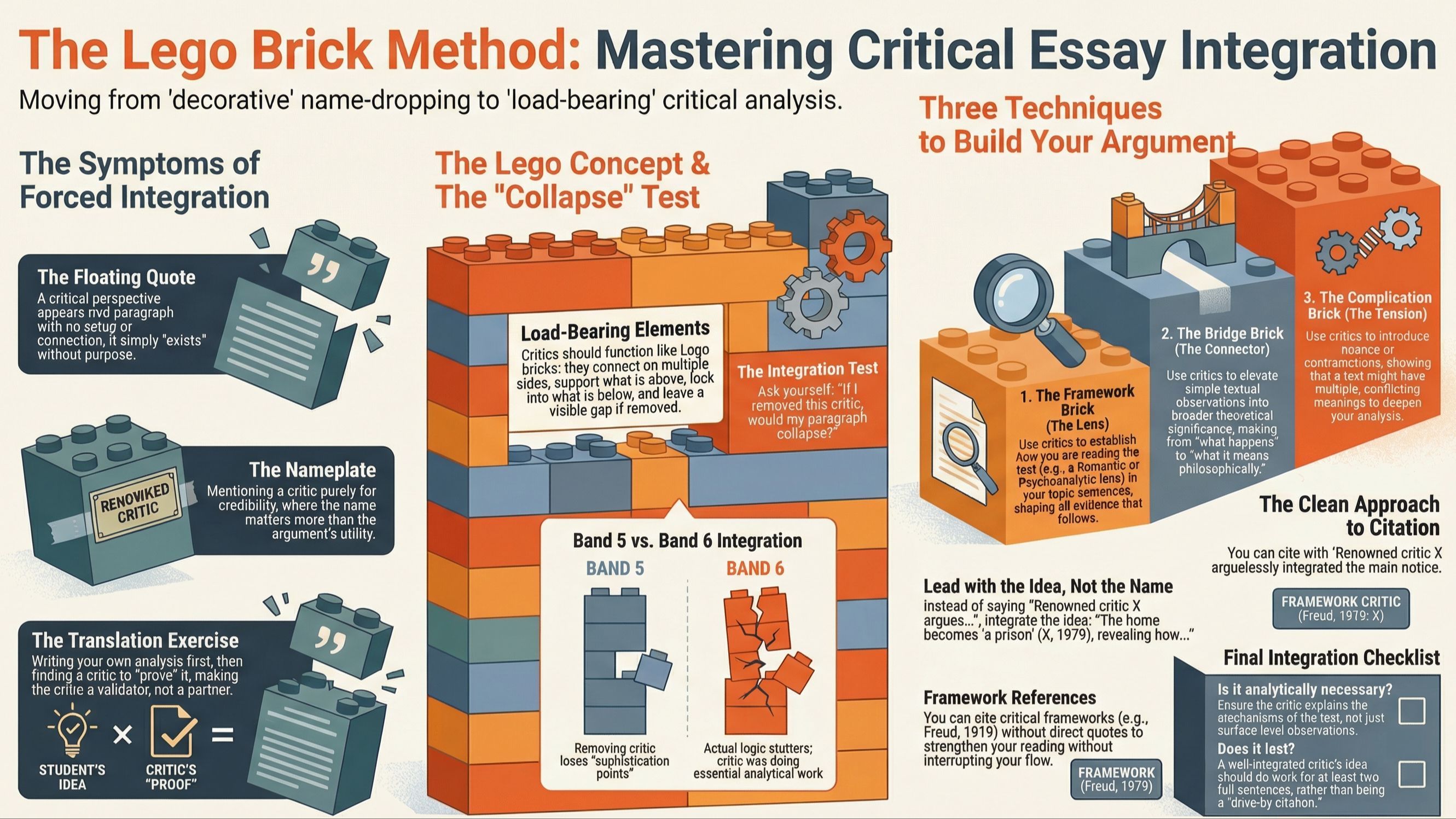
Most students treat critical perspectives like decorative ornaments: find a quote, stick it somewhere, hope it looks sophisticated.
Markers can spot this instantly. The critic appears, says something vaguely relevant, then disappears. No connection to your argument. No integration with textual evidence. Just a name-drop that screams "I needed to tick a rubric box."
Here's the problem: you're trying to insert critics into your essay. What you should be doing is building your argument with them.
Why Most Critical Integration Fails
The three symptoms of forced integration:
- The Floating Quote: A critical perspective appears mid-paragraph with no setup, no connection to what came before or after. It just… exists.
- The Nameplate: You mention a critic purely for credibility, not because their idea actually does work in your analysis. The critic's name matters more than their argument.
- The Translation Exercise: You write your own analysis, then find a critic who said something similar, and awkwardly paraphrase them to "prove" your point. The critic isn't helping you think; they're just validating thoughts you already had.
All three share the same flaw: the critic is an addition to your argument, not a component of it.
The Lego Brick Concept
Think of your argument as a Lego structure. Each element (your claim, textual evidence, critical perspective, analysis) is a brick that clicks into place because its shape fits the specific space.
What makes a Lego brick work:
- It connects on multiple sides, not just one
- It supports what's above it and locks into what's below
- You can see its function in the overall structure
- Removing it would leave a visible gap
Your critical perspectives should function the same way. They shouldn't sit on top of your argument like decoration. They should be load-bearing elements that your analysis builds on and around.
The integration test: If you removed the critical reference, would your paragraph collapse or just lose a fancy quote?
Band 5: The paragraph is shorter; you've just lost some sophistication points.
Band 6: The paragraph's logic stutters; the critic was doing essential analytical work.
A Note on Citation Format
can You don't need to explicitly introduce critics with their full titles and credentials. In fact, doing so often makes integration feel forced.
The clean approach: Quote or paraphrase the critical idea, then cite with (Name, Year).
Instead of: "Renowned feminist critic Sandra Gilbert argues in her seminal work that…"
Try: "The domestic sphere becomes 'a prison disguised as sanctuary' (Gilbert, 1979), revealing how…"
The idea leads. The citation follows. Your analysis continues without interruption.
You can also reference critical frameworks without direct quotes: "Psychoanalytic readings of Gothic texts identify the home as a site of repressed trauma (Freud, 1919), a lens through which…"
The citation proves you're engaging with scholarship. But the scholarship's job is to strengthen your reading, not announce its own importance.
Three Integration Techniques That Actually Work
1. The Framework Brick: Critics as Analytical Lenses
Use critical perspectives to establish how you're reading the text, not what you're saying about it.
Instead of: "Coleridge explores the sublime through natural imagery. As critic John Smith argues, 'the sublime represents nature's overwhelming power.' This is evident when Coleridge describes mountains."
Try: "Reading Coleridge's natural imagery through Romantic conceptions of the sublime, where 'nature's magnitude renders human consciousness peripheral' (Weiskel, 1976), reveals how the text positions individual consciousness against cosmic forces. The mountain's 'immeasurable height' doesn't just describe landscape but establishes the speaker's psychological displacement."
The critical perspective (Romantic sublime theory) becomes your method of reading, not a separate point you're making. It shapes how you interpret every piece of evidence that follows.
When to use framework bricks: Topic sentences, when establishing a paragraph's analytical approach, when you need a lens that applies to multiple textual moments.
2. The Bridge Brick: Critics as Conceptual Connectors
Use critical perspectives to elevate your textual observations into broader theoretical significance.
Instead of: "The narrator describes the wallpaper's pattern repeatedly. This shows her mental state deteriorating."
Try: "The narrator's obsessive tracing of the wallpaper's 'interminable grooves' moves beyond psychological realism into what has been termed 'the semiotics of confinement' (Treichler, 1984). The pattern she cannot escape becomes the visual grammar of her imprisonment; textual repetition mirrors psychological entrapment."
The critical concept (semiotics of confinement) transforms a textual observation (repeated descriptions) into theoretical insight (how form enacts meaning). The critic bridges the gap between what you see in the text and what it means philosophically.
When to use bridge bricks: After presenting textual evidence, when moving from observation to interpretation, when connecting specific textual choices to abstract concepts.
3. The Complication Brick: Critics as Tension Creators
Use critical perspectives to introduce nuance, contradiction, or alternative readings that deepen your argument.
Instead of: "The text celebrates nature. However, ecocriticism suggests nature is also threatening."
Try: "While the text's pastoral imagery initially suggests Romantic celebration of natural harmony, ecocritical reading reveals this harmony depends on indigenous erasure. The 'untouched wilderness' the speaker reveres was never wilderness at all, exposing how 'Romantic nature writing requires systematic forgetting' (Morton, 2007)."
The critical perspective doesn't just add another point; it creates productive tension that drives your argument into complexity.
When to use complication bricks: Second or third paragraphs, when showing interpretive tension, when moving from surface reading to deeper analysis.
The Four Connection Points: Where Critics Click Into Place
Before your claim (Framework): Establishes the theoretical lens shaping your interpretation
After your evidence (Bridge): Elevates textual observation to conceptual significance
Between ideas (Connector): Links your textual reading to broader theoretical questions
Against your claim (Complication): Introduces alternative perspectives that deepen through tension
Each position serves a different structural function. Choose based on what analytical work you need done.
Common Mistakes and Quick Fixes
Mistake: The Paraphrase Sandwich
"Critics argue X. This shows X. Therefore, X."
Fix: Use critics to explain how or why, not to repeat what.
Mistake: The Drive-By Citation
"As Smith notes…" then immediately moving to your own point without engaging the critic's actual argument.
Fix: If you're citing a critic, their idea should do work for at least two full sentences.
Mistake: The Retrospective Validation
Writing your analysis first, then searching for a critic who said something similar.
Fix: Let critical perspectives shape your reading process, not just decorate your final product.
Mistake: The Authority Substitute
Using a critic's reputation to compensate for weak analysis.
Fix: A critic's name adds nothing if their idea doesn't genuinely strengthen your interpretive claim.
Quick Checklist: Is Your Critical Integration Working?
✓ The critic's idea shapes how you read evidence, not just what you say about it
✓ Removing the critical reference would damage your argument's logic
✓ The critical perspective explains mechanisms, not just observations
✓ You engage the idea for multiple sentences, not just name-drop
✓ The critic appears because they're analytically necessary, not decorative
✓ Your reader understands why this critical lens matters for this specific text
Critics aren't proof that you've read widely. They're tools that let you read deeply.
Stop inserting them. Start building with them.